
For every account opened online, 3.36 are abandoned.
Removing fields wins customers back and worries compliance. Verifying at source is the way off that trade-off curve.
For every current account opened online, 3.36 applications are abandoned. That is the 2026 figure from Alkami and Cornerstone's digital banking benchmark, and it has barely moved in years.
In a widely cited consumer survey, 68% said they had given up on a bank application because it was too long or too complex.
The trade-off every onboarding team knows
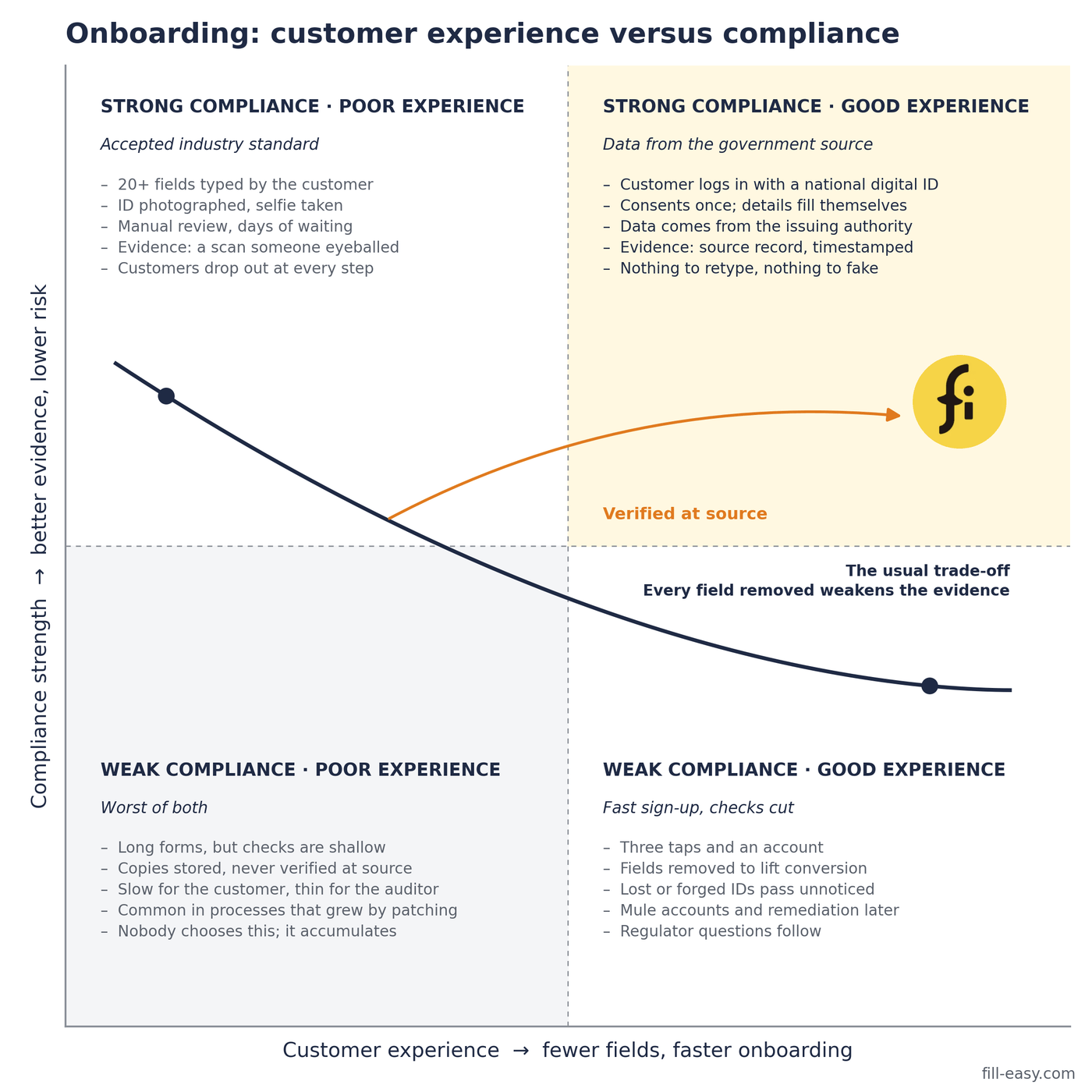
Every field you remove wins some of those customers back. Every field you remove worries compliance.
Where we first saw it
We met this trade-off from the consumer side. Fill Easy started in 2021 as an app that filled in forms for people moving flats. We watched where people gave up: retyping an ID number, photographing a card, waiting for a review.
Banks see the same drop-off, with a regulator watching every field they want to cut.
Getting off the curve
Most onboarding sits somewhere on the curve. The way off it is to verify at source: the customer consents, and the details come from the government record.
- The form fills itself: nothing to retype and no card to photograph.
- The evidence is stronger: a timestamped source record rather than a scan someone eyeballed.
Where does your onboarding sit on this chart?