
Hong Kong securities broker corporate onboarding: SFC AML, CPI and KYB checks
SFC licensed corporations verify corporate investors, owners over 25%, CPI status and omnibus chains under AMLO. Fill Easy: HK$100 per HK search.
Hong Kong · SFC-licensed securities brokers and investment firms (Type 1, 2, 4 and 9) · Securities and Futures Commission (SFC)
Corporate investors, family investment vehicles, funds and overseas intermediaries · Corporate brokerage account opening: AMLO CDD, CPI assessment and KYB
 By Matthew Lee


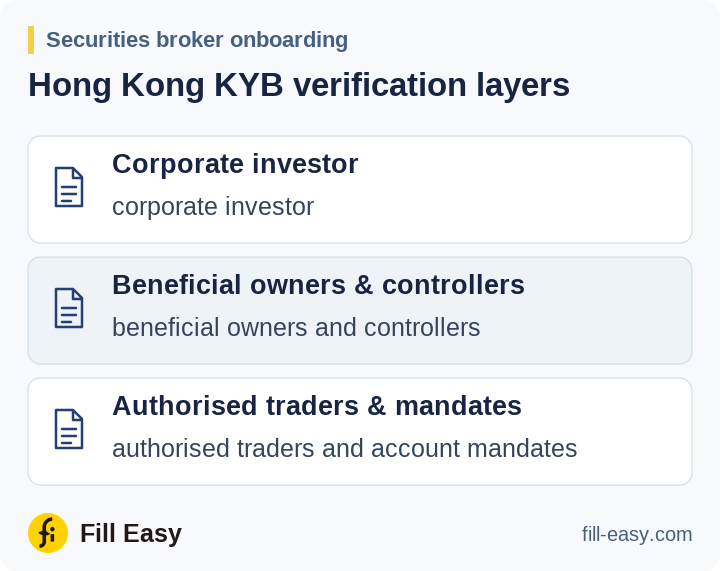
A Hong Kong securities broker or investment firm licensed by the Securities and Futures Commission (SFC) for Type 1 (dealing in securities), Type 2 (dealing in futures), Type 4 (advising on securities) or Type 9 (asset management) applies Schedule 2 of the Anti-Money Laundering and Counter-Terrorist Financing Ordinance (AMLO, Cap. 615) (opens in a new tab) and the SFC AML/CFT Guideline (May 2023) (opens in a new tab). Before executing trades or accepting funds, the firm verifies the company's existence and constitution from an independent registry source, identifies every natural person owning or controlling more than 25% of shares or votes, verifies authorised traders and mandates, and completes investor classification under the SFC Code of Conduct (opens in a new tab).
For a Hong Kong company, Companies Registry Company Particulars and the latest NAR1 annual return prove live status, directors and registered shareholders, while beneficial ownership is corroborated beyond public filings. Fill Easy retrieves Hong Kong Company Particulars with the latest NAR1 for HK$100 per search, automatically and usually within about 15 minutes, alongside BVI (HK$725) and Cayman Islands (HK$525) parent searches.
At a glance
| Law & guidance | AMLO (Cap. 615), Schedule 2; SFO (Cap. 571); SFC AML/CFT Guideline (May 2023, effective 1 June 2023); Code of Conduct paras. 5.1, 5.4 and 15 |
|---|---|
| Regulated firms | SFC Licensed Corporations (Type 1, 2, 4 and 9) and Associated Entities holding client assets |
| Sector exposure | Margin lending, Stock Connect and HKEX execution, omnibus accounts, third-party deposits and order-originator attribution |
| Beneficial owners | More than 25% of issued share capital or voting rights (direct or indirect), or ultimate control over management (para. 4.4.6) |
| Client classification | Corporate Professional Investor (CPI) test (Code para. 15.3A) plus HK$8m portfolio or HK$40m total assets test |
| Verification timing | Before relationship starts; delayed verification only exceptionally under para. 4.7 (30-working-day limit, trading restrictions) |
| Record retention | Five years after closure under AMLO Schedule 2, s. 20; seven years for client agreements and order logs under Cap. 571O |
| Fill Easy pricing | HK$100 per HK search (Company Particulars + NAR1, ~15 min); HK$725 BVI; HK$525 Cayman; confirmed in HKD when ordering |
Regulatory exposure for securities brokers in Hong Kong
Corporate onboarding at an SFC-licensed broker differs materially from commercial banking under HKMA rules. Banks evaluate payment corridors and trade invoices; brokers manage leveraged margin facilities, securities custody, order attribution and cross-border omnibus routing.
- Corporate Professional Investor (CPI) liability. Under paragraph 15 of the SFC Code of Conduct (opens in a new tab), waiving suitability and retail protections for a non-institutional company requires both the quantitative test (HK$8m portfolio or HK$40m total assets under the Professional Investor Rules) and the three-limb CPI assessment under paragraph 15.3A: corporate governance and investment process, competent investment personnel, and product-risk awareness.
- Origin of orders and HKIDR reporting. Code paragraph 5.4 requires identifying who originates each order and who gains its economic benefit. Brokers map corporate accounts and authorised dealers accurately to Legal Entity Identifiers (LEIs) or Broker-to-Client Assigned Numbers (BCANs) for HKEX surveillance.
- Third-party funding and stock deposits. SFC inspections flag unverified third-party remittances and off-market deposits of thinly traded stock into margin accounts as major laundering risks. Brokers verify a designated settlement bank account in the exact client name before accepting inflows.
- Cross-border omnibus accounts. Under chapter 4.20 of the SFC AML/CFT Guideline (opens in a new tab), executing or clearing via an omnibus account for an overseas broker, private bank or fund manager requires correspondent due diligence, home-supervisor review and senior-management sign-off.
Documents and registry evidence
AMLO Schedule 2 sets verification outcomes rather than a fixed form. The Hong Kong company search guide details each Companies Registry record.
| Document | Issued by | What it is checked for |
|---|---|---|
| Company Particulars report | Companies Registry | Live status, BRN, incorporation date, registered office, directors and company secretary (para. 4.3.7) |
| Latest NAR1, NNC1, NSC1 or ND2A | Companies Registry | Registered shareholders, issued capital and recent allotments or director changes |
| Articles of Association | Companies Registry / applicant | Borrowing powers, margin or derivatives authority and board signing rules |
| Ownership chart & SCR extract | Corporate applicant | Intermediate holding layers and declared natural-person controllers over 25% |
| Audited accounts or custodian statements | Auditor / custodian | HK$8m portfolio or HK$40m total-assets test for CPI status and funding capacity |
| Board resolution & trading mandate | Corporate applicant | Express authority for cash, margin, futures or options trading, authorised dealers and settlement bank accounts |
| ID verification of UBOs & traders | Government issuer / iAM Smart | Full name, date of birth, nationality and HKID/passport; Hong Kong residents can verify via iAM Smart |
| Client agreement, W-8BEN-E / CRS & CPI consent | Corporate applicant | Tax classification, risk disclosures, margin terms and written CPI opt-in |
The onboarding workflow, step by step
| Step | Compliance action | Governing rule |
|---|---|---|
| 1. Scope & risk rating | Classify products (equities, margin, futures, OTC derivatives, Type 9) and assign ML/TF risk | SFC AML/CFT Guideline, ch. 2 |
| 2. Entity check | Pull live Company Particulars + NAR1 (or home-registry extracts) and inspect Articles | AMLO Sch. 2, s. 2(1)(a); para. 4.3.7 |
| 3. Ownership & UBOs | Map corporate tiers, inspect SCR or declarations and verify individuals above 25% | AMLO Sch. 2, s. 2(1)(b); para. 4.4 |
| 4. Traders & originators | Verify identity and written board authority of authorised dealers and signatories | Guideline para. 4.5; Code para. 5.4 |
| 5. CPI & suitability | Verify asset thresholds and para. 15.3A governance test; collect written CPI consent | Code of Conduct paras. 15.3A–15.3B |
| 6. Screening | Screen entity, directors, UBOs and traders against UN/HK sanctions, PEPs and adverse media | Guideline ch. 6 |
| 7. Bank check & EDD | Confirm client-named settlement bank account; escalate high-risk or correspondent files | Guideline paras. 4.9.3 and 4.20 |
| 8. Activation & HKIDR | Enable trading lines, assign BCAN or record LEI and set periodic review cycles | Code para. 5.4; Guideline ch. 5 |
Delayed verification under paragraph 4.7 is capped at 30 working days (termination review at 120) with third-party transfers barred; most brokers block live trading until registry checks and mandates close.
Overseas trading vehicles and holding structures
Many Hong Kong brokerage accounts belong to offshore SPVs, family vehicles or funds incorporated in the BVI, the Cayman Islands, Singapore, the UK or mainland China. Under para. 4.3.7, brokers verify overseas companies from home registries or, where public filings omit directors and shareholders, a current Certificate of Good Standing and registered agent's Certificate of Incumbency. For a Part 16 non-Hong Kong company, Company Particulars omits shareholders, so ownership comes from the home registry.
Fill Easy's registry guides cover the BVI (HK$725), the Cayman Islands (HK$525), Singapore (HK$100), the United Kingdom (HK$100), mainland China and overseas companies generally. For PRC-parented vehicles, compliance also verifies the parent's USCC, legal representative and SAMR ownership chain.
Beneficial owners, omnibus accounts and control
AMLO Schedule 2 captures any individual owning or controlling more than 25% of shares or voting rights directly or indirectly, or exercising ultimate management control. Brokers corroborate the Significant Controllers Register against registry filings and share registers (Hong Kong UBO tracing guide).
- Private investment companies and trusts. For offshore SPVs, brokers trace through nominees and trusts to settlors, trustees, protectors and beneficiaries and corroborate source of wealth.
- Omnibus and intermediary accounts. For regulated overseas brokers, private banks or Type 9 managers, chapter 4.20 correspondent controls verify licence status, AML supervision and prompt access to underlying client records. Unregulated intermediaries require full look-through CDD.
- Nominees, fallback and listed carve-outs. Nominee arrangements require identifying the nominator and nominee deed (para. 4.4.19). Senior managing officials apply only if no individual meets the 25% or control test. Companies listed on a specified exchange or qualifying financial institutions qualify for AMLO Schedule 2, s. 4 simplified due diligence once verified.
When enhanced due diligence applies
Under Guideline chapter 4.9 and AMLO Schedule 2, section 15, high-risk files require EDD and senior-management approval:
- Complex offshore chains. Multi-tier SPVs or nominee directors without clear commercial or estate rationale require source-of-wealth corroboration.
- Politically exposed persons (PEPs). Non-Hong Kong and international PEPs always trigger senior-management sign-off, source-of-wealth checks and enhanced monitoring; Hong Kong and former PEPs are assessed risk-sensitively.
- Remote onboarding and high-risk products. Non-face-to-face applicants trigger para. 4.10 safeguards (iAM Smart, certified copies or initial funding from a client-named Hong Kong bank account); margin loans against concentrated small-cap stocks, scrip deposits and FATF high-risk country ties require deeper scrutiny.
Why brokerage applications are delayed or refused
Under AMLO Schedule 2, s. 3(4) and para. 4.13, a broker must decline opening if CDD cannot close and consider an STR to the JFIU. Common blockers include:
- Stale offshore filings or unresolved nominees. Missing fresh Good Standing/Incumbency certificates or withheld share registers and nominee deeds.
- Defective mandates or failed CPI governance. Board resolutions omitting margin, derivatives or client-named settlement accounts, or companies meeting asset tests without a documented investment committee under para. 15.3A.
- Unreconciled screening hits. Pending compliance review of sanctions or adverse media on directors, UBOs or connected issuers.
Ongoing monitoring and record retention
Under Chapter 5 of the SFC AML/CFT Guideline (opens in a new tab), brokers review corporate CDD periodically (at least annually for high-risk accounts) and on trigger events such as officer changes, share transfers or shifts into illiquid stocks. AMLO Schedule 2, s. 20 requires five-year post-closure retention for CDD and transaction records; Cap. 571O mandates seven years for client agreements, trading mandates and order logs.
How Fill Easy supports brokerage compliance teams
Fill Easy supplies primary-source registry extracts, layered ownership records and digital identity results; the licensed corporation retains all risk and approval decisions.
| Onboarding stage | Compliance bottleneck | Fill Easy capability |
|---|---|---|
| Hong Kong entity check | Outdated applicant PDFs instead of live registry filings | CorpVerify: Hong Kong Company Particulars + NAR1 for HK$100, automated in ~15 minutes |
| Offshore SPVs & UBOs | Ordering BVI, Cayman, SG, UK or PRC records separately | CorpVerify: cross-border searches (HK$725 BVI, HK$525 Cayman, HK$100 SG/UK) in one order |
| Remote trader & UBO ID | Manual HKID or passport review for Hong Kong residents | GovVerify: consent-based iAM Smart verification for Hong Kong resident directors, UBOs and traders |
| Periodic & trigger refreshes | Detecting silent officer or shareholding changes across active accounts | Monitoring and remediation: batch Excel re-checks flagging officer, shareholder, status and address updates |
Order via the email agent or automate pulls via the API. Explore workflows for asset management and wealth firms and investment and M&A teams, or contact Fill Easy to align coverage with your SFC manual.
FAQ
Does an SFC-licensed broker follow the same AML statute as a Hong Kong bank?
Both apply AMLO (Cap. 615) Schedule 2, including the >25% beneficial-owner threshold and five-year AML retention. Brokers additionally follow the SFC AML/CFT Guideline (May 2023) and SFC Code of Conduct covering order-originator rules, Corporate Professional Investor assessments, omnibus correspondent checks and seven-year Cap. 571O records.
What qualifies a company as a Corporate Professional Investor in Hong Kong?
The company must meet the Professional Investor Rules threshold (generally an HK$8 million portfolio or HK$40 million total assets) and pass the broker's three-limb governance assessment under Code paragraph 15.3A with signed consent.
Can a BVI or Cayman SPV open a corporate brokerage account in Hong Kong?
Yes. SFC rules do not require a Hong Kong office. Brokers verify the SPV via a current Certificate of Good Standing and registered agent's Certificate of Incumbency, trace every tier to natural persons over 25%, and confirm a client-named settlement bank account.
When must a Hong Kong broker look through an omnibus account?
For a financial institution regulated in Hong Kong or an equivalent jurisdiction, the broker applies chapter 4.20 correspondent controls and verifies underlying investor data is available on request. Unregulated intermediaries require full look-through CDD.
Can iAM Smart verify corporate signatories and traders remotely?
Yes. For Hong Kong resident directors, UBOs and authorised traders onboarding remotely, consent-based iAM Smart verification supplies government-verified identity data under SFC remote-onboarding standards.
How fast and how much are Hong Kong registry searches via Fill Easy?
Fill Easy retrieves Hong Kong Company Particulars with the latest NAR1 for HK$100 per search, automated and usually within about 15 minutes; additional filings are HK$100 each, confirmed in HKD when ordering.