
UK Companies House CS01, PSC register and ECCTA identity checks
How to read a UK Confirmation Statement (CS01), check the PSC register and interpret Companies House mandatory ECCTA identity verification for KYB.
 By Matthew Lee
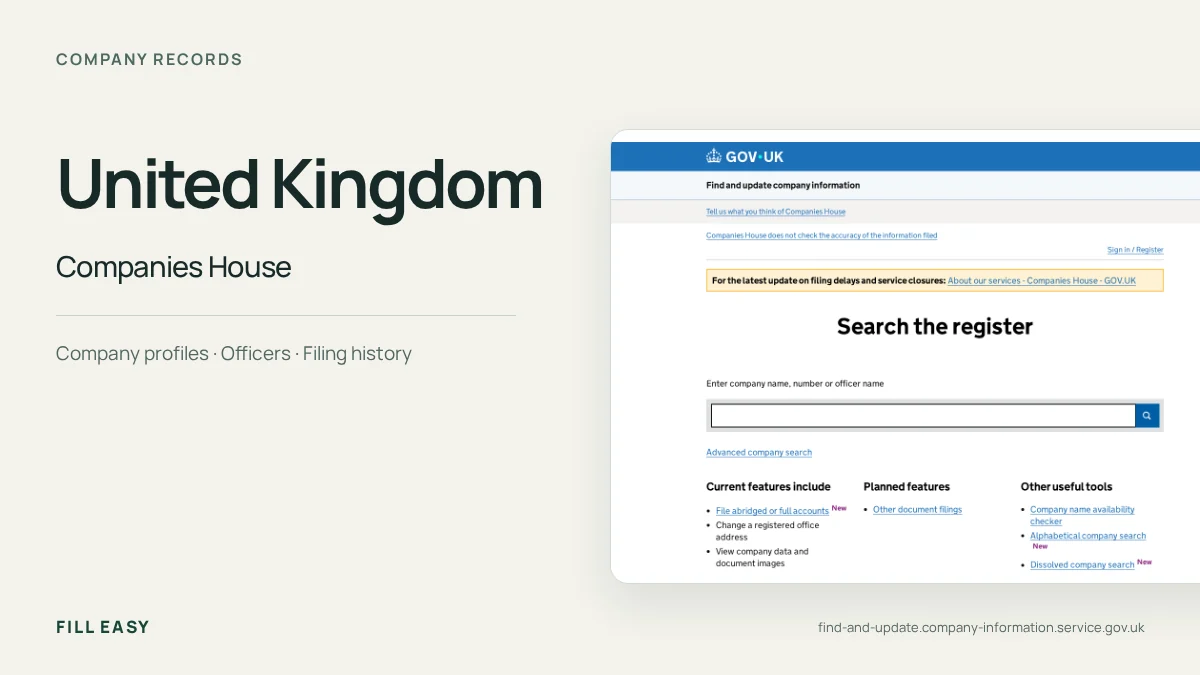

Website capture: Companies House
Reviewing a UK company for bank onboarding, supplier due diligence or M&A requires understanding three linked Companies House records: the Confirmation Statement (CS01), the Persons with Significant Control (PSC) register, and—since 18 November 2025—mandatory identity verification for directors and PSCs introduced under the Economic Crime and Corporate Transparency Act 2023 (ECCTA).
For compliance teams, the critical rule has not changed: Companies House filings provide strong public evidence of shareholders and controlling individuals, but under the UK Money Laundering Regulations 2017 (MLRs 2017) regulated firms still cannot rely solely on the PSC register without checking whether shareholdings or control have changed since the last filing.
At a glance
| Registry | Companies House (England and Wales, Scotland, Northern Ireland) |
|---|---|
| Confirmation Statement (CS01) | Filed at least once every 12 months; confirms registered office, SIC codes, statement of capital and shareholder list |
| PSC Register | Lists individuals or registrable Relevant Legal Entities (RLEs) holding >25% of shares or voting rights, right to appoint/remove majority of directors, or significant influence or control |
| ECCTA mandatory ID verification | Commenced 18 November 2025 with a 12-month transition period to mid-November 2026 for existing directors and PSCs |
| Verification routes under ECCTA | Direct verification with Companies House via GOV.UK One Login, or verification through an Authorised Corporate Service Provider (ACSP) |
| Fill Easy price | HK$100 per UK company search, additional document or financial statements (prices in HKD, confirmed when you order) |
What a Confirmation Statement (CS01) tells you—and what it misses
A UK private company limited by shares files a Confirmation Statement (form CS01) at least once every 12 months, confirming that the company's public record is accurate as at the statement date. The first CS01 and any subsequent CS01 reporting a change include a full list of shareholders and shareholdings.
| Check point on CS01 | What it confirms | Practical KYB catch |
|---|---|---|
| Statement date | Exact cut-off date for the shareholder list | Share transfers after the statement date do not appear until the next CS01—request the company's own register of members if a recent transfer is reported |
| Statement of capital | Share classes, total shares issued, nominal value and voting rights | Different share classes can carry unequal voting rights, so share count alone does not always equal voting control |
| Shareholder names and holdings | Immediate legal shareholders of the UK company | If a shareholder is an overseas company (for example BVI or Cayman), follow that entity's own registry records |
| Registered email and lawful purpose statement | Required under ECCTA reforms | Missing or overdue confirmation statements are an active compliance warning sign |
Reading the PSC register accurately
Under Part 21A of the Companies Act 2006, UK companies must identify and file every Person with Significant Control (PSC)—normally any individual meeting one or more of five conditions: directly or indirectly holding more than 25% of shares, holding more than 25% of voting rights, holding the right to appoint or remove a majority of the board, exercising significant influence or control, or exercising significant influence or control over a trust or firm that meets one of the first four conditions.
Three points matter when reading a PSC entry:
- Relevant Legal Entity (RLE): Where a UK company is owned by another UK company (or a company listed on a specified regulated market) that maintains its own PSC register, the parent appears as a registrable RLE. You still need to inspect the parent's PSC filings to identify the natural persons at the top.
- Discrepancy reporting: Under regulation 30A of the MLRs 2017, UK AML-regulated firms must report material discrepancies between the PSC register and the beneficial-ownership evidence they gather during onboarding or ongoing review.
- Threshold alignment: Where an institution applies a stricter internal threshold (for example 10% for higher-risk customers), the public >25% PSC register will not list minority holders between 10% and 25%; check the CS01 shareholder list instead.
ECCTA mandatory identity verification (from 18 November 2025)
Historically, Companies House acted largely as a passive repository that did not verify whether directors or PSCs were real people. Under the Economic Crime and Corporate Transparency Act 2023, Companies House launched voluntary verification on 8 April 2025 and commenced mandatory identity verification on 18 November 2025 with a 12-month transition period for existing roles:
Companies House confirms that from Tuesday 18 November 2025, legal requirements for directors and people with significant control (PSCs) of companies to verify their identities will begin.
Companies House: Identity verification rollout from 18 November 2025 (GOV.UK) (opens in a new tab)
| Role | Mandatory verification timing | How it appears on the register |
|---|---|---|
| New directors (incorporation or appointment from 18 November 2025) | Must verify identity before incorporating a company or being appointed as a director | Verified status linked via Companies House personal code |
| Existing directors | Must confirm identity verification (with personal code) when filing the company's next annual Confirmation Statement during the 12-month transition | Overdue verification blocks compliant CS01 filing and flags compliance risk |
| New PSCs (from 18 November 2025) | Must submit identity verification statement and personal code within 14 days of incorporation or notification | Recorded on the PSC entry; unverified status after due date is a red flag |
| Existing PSCs | Must verify within their appointed 14-day window during the 12-month transition (tied to the confirmation statement date if also a director, or birth month if not) | Check verification due dates and completion on the register |
Verification takes place either directly with Companies House through GOV.UK One Login or through a registered Authorised Corporate Service Provider (ACSP) (such as an AML-supervised UK accountant, solicitor or company formation agent). While ECCTA makes the UK register significantly more trustworthy against bogus directors, Companies House verification does not replace a regulated firm's own AML/KYC obligations under the MLRs 2017.
Ordering UK company records through Fill Easy
Fill Easy retrieves UK Companies House company profiles, CS01 filings, financial statements and additional documents for HK$100 per search or document (see the UK Companies House search guide and UK corporate bank account opening). Order via email or the REST API alongside overseas parent-company searches in one request.
FAQ
Does Companies House ECCTA identity verification replace a bank's own KYC check?
No. Mandatory identity verification under ECCTA improves the integrity of the public register by confirming directors and PSCs are real people, but UK-regulated banks, insurers and obliged firms must still carry out their own CDD under the Money Laundering Regulations 2017.
When did mandatory Companies House identity verification start?
Voluntary verification opened on 8 April 2025, and mandatory identity verification for new directors and PSCs began on 18 November 2025, with a 12-month transition period for existing directors and PSCs.
How current is the shareholder list on a UK Confirmation Statement (CS01)?
It reflects shareholders as at the statement date of the most recent CS01 filed (at least annually). If shares changed hands after that date, request the company's internal register of members and stock transfer forms.
What is a Relevant Legal Entity (RLE) on the UK PSC register?
An RLE is a corporate shareholder—usually another UK company or a company listed on a specified regulated market—that meets the PSC control conditions and maintains its own ownership disclosures. Reviewers must follow the RLE up the chain to identify natural-person beneficial owners.
How much does a UK company search cost through Fill Easy?
Fill Easy charges HK$100 per UK company search, additional document or set of financial statements. Prices are in HKD and confirmed when you order.