
US broker-dealer corporate onboarding: SEC, FINRA Rules 2090 & 3310, CIP and CDD
US SEC/FINRA broker-dealers verify companies, 25% owners, controllers and omnibus accounts under 31 CFR 1023.220. Fill Easy: US state search HK$100.
United States · SEC-registered and FINRA-member broker-dealers (introducing and clearing firms) · SEC, FINRA and FinCEN
US corporations, LLCs, hedge funds, foreign trading vehicles and foreign broker-dealers · Corporate brokerage account opening: 31 CFR 1023.220 CIP, CDD Rule and FINRA KYC
 By Matthew Lee


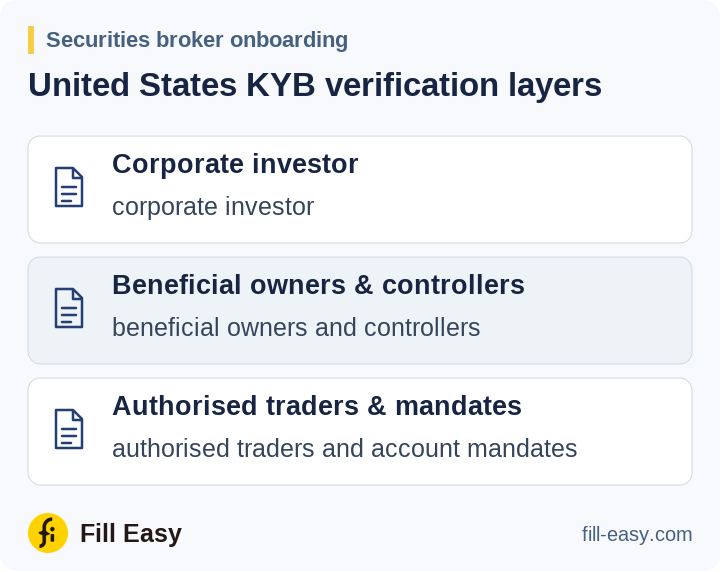
A US broker-dealer registered with the Securities and Exchange Commission (SEC) and regulated by FINRA onboards corporate clients under two Bank Secrecy Act rules — the broker-dealer Customer Identification Program rule (31 CFR 1023.220 (opens in a new tab)) and the FinCEN Customer Due Diligence rule (31 CFR 1010.230 (opens in a new tab)) — alongside FINRA Rule 2090 (opens in a new tab) (Know Your Customer), FINRA Rule 3310 (opens in a new tab) (AML Compliance Program) and FINRA Rule 4311 (opens in a new tab) (Carrying Agreements). Before activating an institutional or corporate account, the broker collects name, physical address and TIN, verifies corporate existence, identifies natural persons owning 25% or more equity plus one control person, verifies authorised traders and screens against OFAC lists.
US state corporate registries — including Delaware, New York and Wyoming — rarely publish shareholders, and US-formed entities are exempt from federal Corporate Transparency Act reporting since March 2025, so broker-dealers pair state filings with signed beneficial-ownership certifications and governance records. Fill Easy retrieves US state company records for HK$100 per search — turnaround confirmed when ordering — alongside Cayman (HK$525), BVI (HK$725), UK (HK$100), Hong Kong (HK$100) and Singapore (HK$100) parent searches.
At a glance
| Law & rules | Bank Secrecy Act; Exchange Act of 1934; 31 CFR 1023.220 (CIP), 1010.230 (CDD), 1010.610 (FFI correspondent); FINRA Rules 2090, 3310 and 4311 |
|---|---|
| Supervisors | SEC, FINRA and FinCEN (plus OFAC for sanctions) |
| Regulated firms | Introducing broker-dealers, clearing/carrying firms, prime brokers and institutional desks |
| Sector exposure | Introducing/clearing reliance, FFI omnibus accounts, low-priced/microcap stock deposits, margin/DVP settlement and OFAC sanctions |
| Beneficial owners | Ownership prong: 25% or more equity directly or indirectly (up to four individuals); control prong: always one executive officer or manager (1010.230(d)) |
| Verification timing | Identifying data obtained before opening; verification within a reasonable time before or after opening under firm CIP controls (1023.220(a)(2)) |
| Institutional status | FINRA Rule 4512(c) institutional account (US$50m total assets or regulated entity) and Rule 2111(b) suitability |
| Record retention | Five years after closure for CIP/CDD identifying records and five years after verification record creation; SEC Rule 17a-4 (typically six years) |
| Fill Easy pricing | HK$100 per US state company search and per additional filing; HK$725 BVI; HK$525 Cayman; turnaround confirmed in HKD when ordering |
Regulatory exposure for securities brokers in United States
US broker-dealers face securities-market compliance rules distinct from commercial banking under 31 CFR 1020.220:
- Introducing vs clearing reliance (FINRA Rule 4311 and FinCEN reliance). US brokerage frequently splits client relationships (introducing firm) from custody and settlement (carrying/clearing firm). FINRA Rule 4311 (opens in a new tab) requires carrying agreements to allocate KYC and supervisory duties explicitly, and any CIP or CDD reliance must satisfy 31 CFR 1023.220(a)(6) and 1010.230(j): reasonable reliance on a federally regulated firm under a written contract with annual certification.
- FINRA Rule 2090 essential facts and authority. FINRA Rule 2090 (opens in a new tab) obliges firms to know the essential facts of every customer and the authority of every person acting on the account — including advisers, trading desks and margin or options signatories.
- Foreign financial institution (FFI) omnibus accounts. Under 31 CFR 1010.610 (opens in a new tab), clearing and prime brokers maintaining omnibus securities accounts for foreign broker-dealers, banks or funds must evaluate home-country AML supervision, expected activity and nested-account exposure.
- Microcap deposits and Rule 3310 surveillance. SEC and FINRA actions target firms onboarding offshore or shell corporations depositing low-priced OTC shares for rapid liquidation. Rule 3310(f) requires ongoing risk-based CDD to flag suspicious trading.
Documents and registry evidence
31 CFR 1023.220 requires documentary and non-documentary verification establishing a reasonable belief in true identity. The US company search guide explains state records, and the Delaware company search guide details the main formation state.
| Document | Issued by | What it is checked for |
|---|---|---|
| State entity extract & Certificate of Good Standing | Secretary of State | Legal name, file number, entity type, active status and registered agent (1023.220(a)(2)(ii)(A)) |
| Certified Articles of Incorporation / Formation | Formation state | Corporate existence — the regulation's primary documentary example |
| IRS Form W-9 (EIN) or Form W-8BEN-E | IRS / applicant | TIN for US entities, or FATCA/chapter 3 status for foreign entities |
| FinCEN Beneficial Ownership Certification | Authorised opener | Name, street address, date of birth and SSN/passport for 25%+ equity owners and one control person (1010.230(b)(1)) |
| Operating agreement, bylaws or stock ledger | Corporate applicant | Indirect equity holders through holding LLCs or partnership tiers |
| Corporate resolution & margin/options mandate | Corporate applicant | FINRA Rule 2090 authority for cash, margin, short selling, options, prime brokerage and named traders |
| Photo ID of UBOs, controller & traders | Government issuer | Risk-based identity verification (photocopies permitted under 1010.230(b)(2)) |
| Institutional questionnaire, financials & FFI pack | Applicant / foreign FI | FINRA Rule 4512(c) US$50m asset check and 31 CFR 1010.610 correspondent due diligence |
The onboarding workflow, step by step
| Step | Compliance action | Governing rule |
|---|---|---|
| 1. CIP notice | Provide adequate prior notice of federal identity-verification requirements | 31 CFR 1023.220(a)(5) |
| 2. Core CIP data | Collect legal name, physical street address and TIN/EIN (or foreign ID) before opening | 31 CFR 1023.220(a)(2)(i) |
| 3. Entity check | Verify existence via state filings, certified formation records and/or non-documentary checks | 31 CFR 1023.220(a)(2)(ii) |
| 4. Beneficial owners | Obtain signed certification for 25%+ owners and one control person; verify risk-sensitively | 31 CFR 1010.230(b), (d) |
| 5. Authority & class | Confirm authorised traders, margin/options powers and FINRA Rule 4512(c) institutional status | FINRA Rules 2090, 4512(c) |
| 6. OFAC screening | Screen entity, officers, UBOs, control person and traders against OFAC lists and FinCEN 314(a) | 31 CFR 1023.220(a)(4); OFAC |
| 7. Risk & reliance | Document account purpose and execute carrying/reliance certifications between introducing and clearing firms | FINRA Rules 3310(f), 4311 |
| 8. Decision & records | Activate account, restrict while verifying, or decline and evaluate SAR filing (31 CFR 1023.320) | 31 CFR 1023.220(a)(2)(iii), (3) |
Under FinCEN ruling FIN-2026-R001 (13 February 2026), broker-dealers need not re-collect a fresh beneficial-ownership certification for every subsequent sub-account opened by an existing corporate customer unless risk triggers arise.
Overseas trading vehicles and holding structures
US broker-dealers in New York, Chicago, Boston and San Francisco onboard Cayman master-feeder funds, BVI trading companies and non-US corporate treasuries. Under 31 CFR 1010.230(e)(1), foreign legal entities fall under the CDD Rule. Without a US TIN, a foreign entity provides a foreign government-issued ID number and country of issuance — or alternative government documentation certifying existence (1023.220(a)(2)(i)(A)(4)). Foreign companies registered to do business in a US state still report non-US beneficial owners to FinCEN under the Corporate Transparency Act.
Fill Easy's registry guides cover Delaware (HK$100), New York (HK$100), California (HK$100), the Cayman Islands (HK$525), the BVI (HK$725), Bermuda, the United Kingdom (HK$100), Hong Kong (HK$100), Singapore (HK$100) and overseas companies generally.
Beneficial owners, omnibus accounts and control
31 CFR 1010.230(d) mandates two prongs: every natural person owning 25% or more equity directly or indirectly (up to four individuals) plus always one individual with significant management control (CEO, managing member or general partner).
- US capital-markets exclusions. US-listed issuers (Exchange Act s. 12 or s. 15(d)), SEC-registered investment advisers, registered investment companies, broker-dealers and clearing agencies are excluded (1010.230(e)(2)). Foreign-listed companies are not automatically excluded, though public disclosures support verification; vehicles managed by non-SEC-registered foreign advisers require control-prong identification.
- Foreign omnibus accounts. Under 31 CFR 1010.610, omnibus accounts for foreign broker-dealers or banks require risk-based correspondent diligence, nested-account checks and — for offshore-licensed or high-risk non-public foreign banks under 1010.610(b) — 10%+ owner identification.
- Trusts and OFAC 50 Percent Rule. Where a trust owns 25%+, the trustee is the beneficial owner (1010.230(d)(3)). Separately, OFAC's 50 Percent Rule blocks entities owned 50%+ in aggregate by SDN-listed persons even where individual stakes sit below 25%.
When enhanced due diligence applies
FINRA Rule 3310 and BSA rules trigger enhanced diligence in four brokerage scenarios:
- Non-US private banking accounts (31 CFR 1010.620). Managed accounts of US$1,000,000+ for non-US corporate vehicles owned by non-US persons require identifying nominal and beneficial owners, checking source of funds and applying enhanced scrutiny to senior foreign political figures (PEPs).
- Foreign omnibus and DMA. Omnibus accounts for foreign brokers in higher-risk jurisdictions or offering sub-account DMA require pre-trade controls and periodic review.
- Microcap deposits and Section 311. Low-priced OTC share deposits trigger Section 5 registration and acquisition-history checks; OFAC sanctions, Section 311 special measures or FATF call-for-action ties trigger escalation or prohibition.
Why brokerage applications are delayed or refused
Under 31 CFR 1023.220(a)(2)(iii), a broker-dealer unable to form a reasonable belief in customer identity must decline or close the account and evaluate a SAR (31 CFR 1023.320). Common blockers include:
- Mismatched state and IRS records. Discrepancies across Secretary of State filings, EIN letters (CP 575 / 147C) and application forms.
- Incomplete CDD certifications. Refusal to trace indirect 25%+ equity tiers or name an individual under the control prong.
- Carrying-firm exceptions. Clearing brokers rejecting offshore SPVs or microcap profiles that cleared an introducing broker's initial review.
- Defective mandates or funding. Resolutions omitting options, margin or FINRA Rule 2090 trader authority, third-party wires or restricted shares lacking legal opinions.
Ongoing monitoring and record retention
FINRA Rule 3310(f) requires ongoing risk-based monitoring for suspicious trading (wash trades, spoofing, rapid wire-in/wire-out without execution, penny-stock surges) and event-driven refreshes of corporate status and beneficial owners. Under 31 CFR 1023.220(a)(3) and 1010.230(i), identifying records are kept for five years after closure and verification records for five years after creation; SEC Rules 17a-3 and 17a-4 mandate parallel non-rewritable electronic retention (typically six years).
How Fill Easy supports brokerage compliance teams
Fill Easy retrieves official US Secretary of State records and cross-border holding filings while the broker-dealer retains all CIP and CDD decisions.
| Onboarding stage | Compliance bottleneck | Fill Easy capability |
|---|---|---|
| US state verification | Navigating 50+ state portals with inconsistent formats and good-standing rules | CorpVerify: US state company searches and additional filings at HK$100 per state search |
| Offshore SPVs & funds | Verifying Cayman, BVI, UK, HK or Singapore parent tiers behind US accounts | CorpVerify: cross-border searches (HK$525 Cayman, HK$725 BVI, HK$100 UK/HK/SG) in one order |
| CIP audit trail | Documenting source, timestamp and discrepancy checks under 1023.220(a)(3) | Primary-source extracts with English summaries, timestamps and internal reference IDs |
| Ongoing refreshes | Detecting dissolved entities, name changes or status lapses across active accounts | Monitoring and remediation: batch Excel re-checks flagging status, officer and filing changes |
Order via the email agent or automate pulls via the API. Explore workflows for asset management and wealth firms and investment and M&A teams, or contact Fill Easy to align registry coverage with your FINRA Rule 3310 programme.
FAQ
Which federal CIP rule applies to US broker-dealers instead of banks?
US broker-dealers apply 31 CFR 1023.220 for their Customer Identification Program rather than the bank rule at 31 CFR 1020.220, alongside SEC books-and-records rules and FINRA Rules 2090, 3310 and 4311.
What is the beneficial-ownership rule for US corporate brokerage accounts?
Under 31 CFR 1010.230, broker-dealers identify every individual owning 25% or more equity directly or indirectly (up to four individuals) plus always one executive officer or senior manager under the control prong.
Can a clearing broker rely on an introducing broker's KYC checks?
Yes, when the FINRA Rule 4311 carrying agreement allocates responsibilities clearly and reliance satisfies 31 CFR 1023.220(a)(6) and 1010.230(j), including a written contract with annual AML certification.
Do US state company registries list shareholders or beneficial owners?
No. State Secretaries of State such as Delaware and New York record corporate status and registered agents rather than shareholders, and US-formed entities are exempt from Corporate Transparency Act reporting since March 2025, so broker-dealers rely on signed certifications plus governance records.
Are SEC-registered advisers and US-listed companies exempt from UBO collection?
Yes. Under 31 CFR 1010.230(e)(2), US-listed issuers, SEC-registered investment advisers, registered investment companies and regulated US broker-dealers are excluded; foreign-listed companies are not automatically excluded.
How much does a US state company search cost through Fill Easy?
Fill Easy retrieves US state company records at HK$100 per state search and HK$100 per additional filing, with Cayman (HK$525) and BVI (HK$725) parent searches available in the same order and HKD pricing confirmed when ordering.