
Trade compliance and supply-chain KYB in Latin America
Latin America trade compliance KYB: verify corporate counterparties via Brazil CNPJ/QSA, Mexico SAT/RFC, Colombia, Chile and Argentina registries.
Latin America · Importers, exporters, commodity traders and cross-border procurement teams · Brazil Receita Federal & CGU, Mexico SAT & Economía, Colombia DIAN, Chile Aduanas & SII, Argentina ARCA/IGJ
Corporate suppliers, customs brokers, distributors and joint-venture partners · Trade compliance, origin verification and anti-corruption KYB
 By Matthew Lee
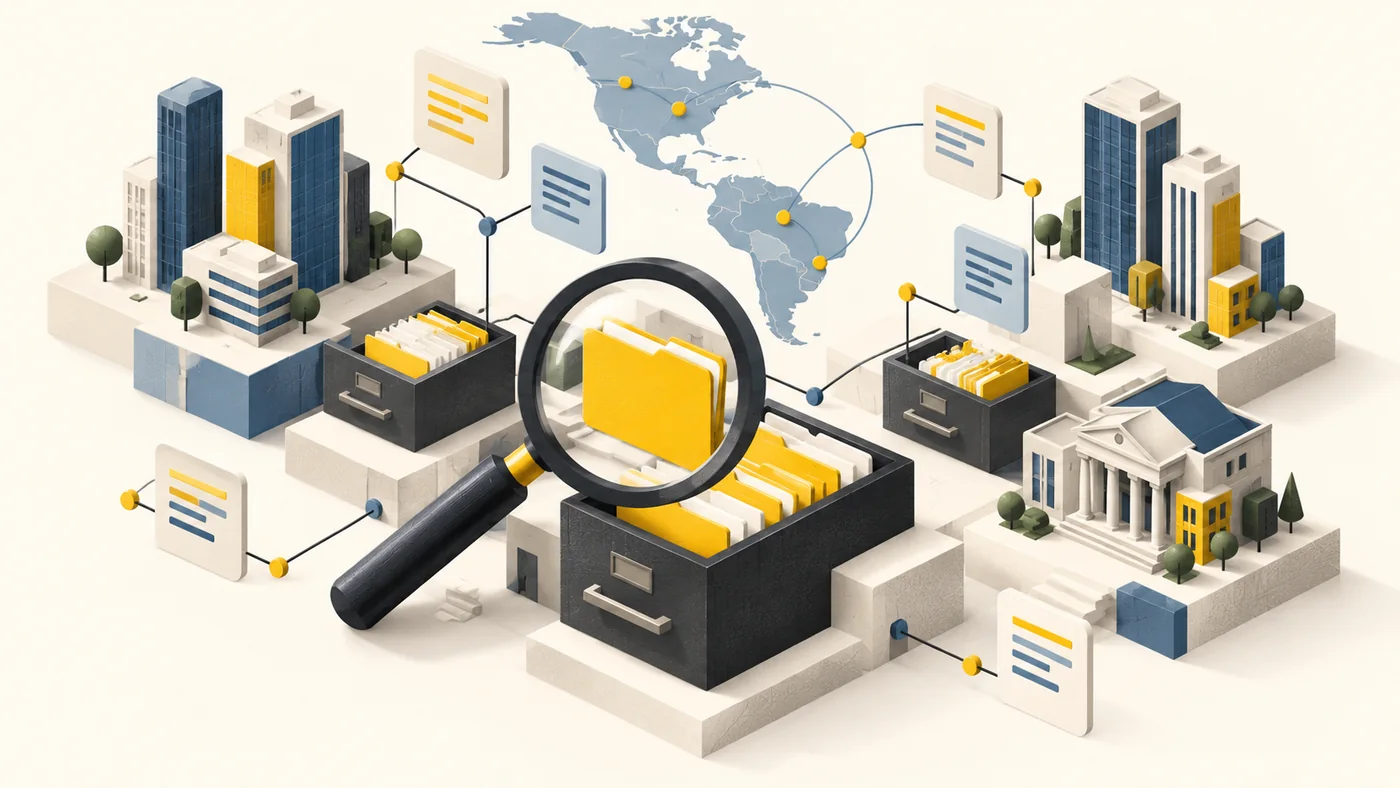

Cross-border trade across Latin America — anchored by São Paulo, Mexico City, Bogotá, Santiago and Buenos Aires — combines customs-importer habilitation, preferential rules-of-origin audits, tax-invoice blacklists and strict domestic and extraterritorial anti-corruption enforcement. Exporters, commodity buyers and procurement teams must confirm that each Latin American supplier, distributor or customs broker holds active tax and foreign-trade standing, avoids debarment or phantom-invoicer lists and has transparent corporate ownership.
Public company data across the region is split between federal tax authorities and state or municipal commercial registries: Brazil's Receita Federal publishes a nationwide CNPJ and QSA extract listing direct partners and administrators, whereas Mexico, Argentina and Chile require pairing federal tax identifiers with state or notarial corporate records. Fill Easy retrieves company searches for HK$100 in Brazil, Chile and Argentina and HK$210 in Mexico; Colombia availability and pricing are confirmed when you order.
At a glance
| Core regional hubs | São Paulo, Mexico City, Bogotá, Santiago, Buenos Aires |
|---|---|
| Key authorities | Brazil Receita Federal, Siscomex & CGU; Mexico SAT; Colombia DIAN; Chile Aduanas & SII; Argentina ARCA & IGJ |
| Core trade risks | Mexico SAT Art. 69-B phantom invoicers, Brazil CEIS/CNEP debarment, USMCA origin audits, anti-corruption and OFAC sanctions |
| Registry split | Federal tax IDs (CNPJ, RFC, NIT, RUT, CUIT) govern customs; signing powers and deeds sit in commercial registries |
| Beneficial ownership access | Mandatory tax UBO filings (Brazil IN RFB 2.119/2022, Colombia DIAN RUB, Mexico CFF) are closed to the public |
| Fill Easy pricing | HK$100 in Brazil, Chile and Argentina; HK$210 in Mexico; Colombia confirmed when you order |
| Turnaround | Confirmed when you order; prices in HKD |
Regulatory exposure for trade compliance in Latin America
In Brazil, every corporate importer or exporter must maintain an active CNPJ with Receita Federal do Brasil (opens in a new tab) and hold foreign-trade habilitation (RADAR) through Portal Único Siscomex (opens in a new tab). Trade teams must also screen Brazilian counterparties against the Controladoria-Geral da União (CGU) sanctions registers (opens in a new tab) — CEIS (debarred entities) and CNEP (entities penalised under Brazil's Clean Company Act, Law No. 12.846/2013) — to manage domestic and FCPA anti-corruption exposure.
In Mexico, counterparty verification centres on the Servicio de Administración Tributaria (SAT) (opens in a new tab) and the RFC tax number. Dealing with companies listed under Article 69-B of the Federal Fiscal Code (EFOS — sham-invoice issuers) risks tax disallowances and customs penalties. Mexican exporters claiming duty-free entry under the United States-Mexico-Canada Agreement (USMCA) (opens in a new tab) must also substantiate Chapter 4 rules of origin and physical manufacturing capacity during CBP or Mexican origin verifications.
In Colombia, DIAN (opens in a new tab) administers the RUT tax register, customs user authorisations and the Registro Único de Beneficiarios Finales (RUB), while local Chambers of Commerce issue legal-representation certificates. In Chile, Servicio Nacional de Aduanas (opens in a new tab) enforces customs and FTA origin rules alongside SII tax registration. In Argentina, ARCA (formerly AFIP) administers CUIT tax and customs standing alongside strict FX controls and corporate filings at IGJ in Buenos Aires or provincial registries. Across all five hubs, US-dollar settlement and US-origin inputs also require screening against OFAC SDN and transnational criminal organisation lists.
Documents and registry evidence
Defensible Latin American KYB pairs a federal tax-status record with a commercial-register extract or notarised deed proving who can legally bind the counterparty.
| Document | Issued by | What it is checked for |
|---|---|---|
| CNPJ & QSA Extract | Brazil Receita Federal | 14-digit CNPJ, active/inapta status, CNAE activities, address, direct Ltda. partners (sócios) and administrators |
| Certidão Simplificada / Contrato Social | Brazilian State Junta Comercial (e.g. JUCESP) | Share capital, corporate object, management powers, signatory rules and amendments |
| RPC Extract & Constancia de Situación Fiscal | Mexico Secretaría de Economía / SAT | Incorporation folio, legal representatives (apoderados), active RFC status, fiscal domicile and Art. 69-B status |
| Certificado de Existencia y Representación Legal & RUT | Colombian Cámara de Comercio / DIAN | Active registration, legal-representative signing caps, statutory auditor, NIT and customs codes |
| Certificado de Vigencia / RES or Conservador Extract | Chile Conservador de Bienes Raíces or RES | Active standing, RUT, founding partners/shareholders, administrators and signing powers |
| IGJ / Provincial Extract & Constancia de CUIT | Argentina IGJ (or province) / ARCA | CUIT number, active tax/customs status, corporate form, board authorities and domicile |
| Notarised POA, UBO Declaration & Origin Certificate | Counterparty | Specific monetary signatory caps, natural-person UBOs and USMCA/FTA factory-level origin proof |
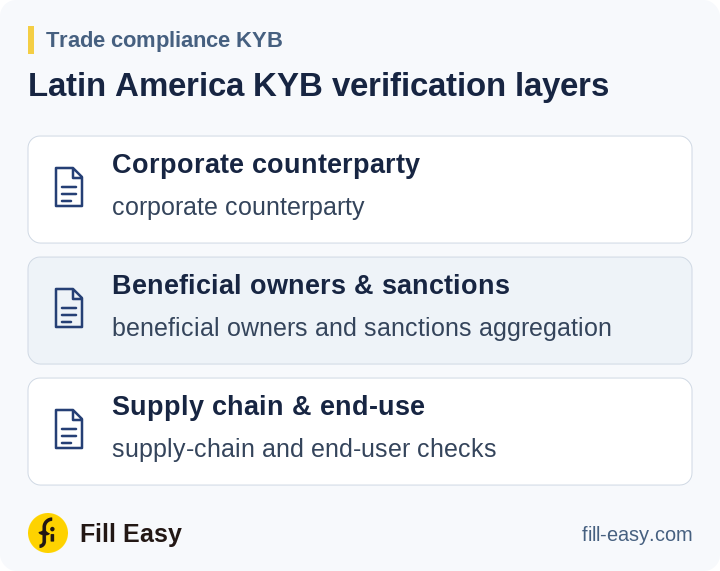
Two regional limitations matter directly. First, Brazil's CNPJ/QSA discloses direct partners for Sociedade Limitada (Ltda.) entities, but for a Sociedade Anônima (S.A.) it generally lists officers rather than shareholders — requiring the private share register (Livro de Registro de Ações) or CVM filings if listed. Second, in Mexico and Colombia, legal-representative signing powers (poderes) frequently carry monetary caps or exclude guarantees and export indemnities.
The compliance workflow, step by step
| Step | Action | Source |
|---|---|---|
| 1. Tax ID & legal capture | Collect exact Portuguese/Spanish legal name, tax ID (CNPJ, RFC, NIT, RUT, CUIT) and plant or warehouse address | Onboarding form; tax certificate |
| 2. Tax & customs standing | Confirm active tax status, customs habilitation (Siscomex/RADAR, DIAN RUT codes) and clean tax-blacklist status | Receita Federal, SAT Art. 69-B, DIAN, SII, ARCA |
| 3. Commercial & signatory check | Confirm active incorporation, authorised activities and legal-representative signing limits | Junta Comercial, Mexico RPC, Cámara de Comercio, Chile RES/CBR, Argentina IGJ |
| 4. Ownership & UBO mapping | Extract direct partners where published and collect notarised deeds, share ledgers and parent extracts for corporate layers | Home and overseas registries; signed UBO declaration |
| 5. Anti-corruption & sanctions screening | Screen entity, administrators, apoderados, partners and UBOs against domestic debarment and global sanctions lists | Brazil CEIS/CNEP, OFAC SDN/TCO, World Bank/IDB, EU/UK lists, PEP databases |
| 6. Origin & substance check | Verify physical plant capacity and upstream inputs for USMCA or FTA origin claims | Factory filings, customs codes, tier-two supplier extracts |
| 7. Clearance & retention | Log decision, embed anti-corruption and origin indemnities and retain records for 5–10 years | Compliance archive |
Running steps 2 and 3 together catches a frequent regional hazard: an entity can look active at a state commercial registry while its federal tax ID is suspended (inapta in Brazil or listed under SAT Article 69-B in Mexico), blocking customs clearance.
Cross-border counterparties and multi-layer ownership
Latin American exporters and nearshoring plants routinely pair local operating entities in São Paulo, Monterrey, Bogotá or Santiago with holding companies in Delaware, Spain, Hong Kong or offshore centres. Verify each corporate parent in its own home registry.
Check exact registry coverage across Brazil, Mexico (HK$210), Colombia, Chile and Argentina. Where parents sit in North America or Europe, combine those searches with United States, Delaware, Spain (HK$155) and verifying an overseas company.
Beneficial owners, control and sanctions aggregation
Brazil's IN RFB 2.119/2022 (25% or significant-influence threshold), Colombia's DIAN RUB (5% threshold) and Mexico's Federal Fiscal Code beneficiario controlador rules mandate beneficial-ownership reporting to tax authorities, yet none of those databases is publicly searchable. Trade teams must build ownership independently from commercial records (Brazil QSA, Junta Comercial deeds, Chile RES), private share ledgers and foreign parent extracts.
Apply OFAC's 50% aggregation rule for sanctions screening and lower 5%–10% thresholds wherever counterparties deal with customs authorities, state-owned energy or mining firms or public tenders, where minority stakes held by politically exposed persons create acute bribery exposure.
When enhanced due diligence applies
- USMCA nearshoring transshipment: Recently formed Mexican exporters shipping Asian-origin steel, aluminium, electronics or auto parts into the United States without verifiable local factory capacity.
- Customs and public-sector intermediaries: Despachantes aduaneiros, agentes aduanales, port agents or local consultants paid commission fees.
- Tax-blacklist indicators: Links to Mexico SAT Article 69-B entities, irregular Brazilian CNPJ statuses, virtual addresses or rapid representative turnover.
- High-risk commodity corridors: Timber, gold, beef, soy or minerals carrying deforestation, illegal-mining or cartel-financing exposure.
- Offshore holding layers: Local operators owned through Panama, BVI or Delaware shells without identified natural-person owners.
Common bottlenecks and refusal triggers
- Provincial registry fragmentation: Searching a single national portal when commercial filings sit across 32 Mexican states or 24 Argentine jurisdictions.
- Capped signing powers: Accepting a supply contract or origin certificate signed by a representative whose notarised poder caps commitment value.
- Stale notarial deeds: Relying on an old Contrato Social or Acta Constitutiva missing recent partner exits or board replacements.
- Missing customs habilitation: Shipping before confirming active Brazilian Siscomex/RADAR or Colombian DIAN importer status.
- Unscreened affiliates: Checking only the contracting entity and missing a sister company or partner listed on Brazil's CEIS/CNEP or OFAC's SDN List.
Ongoing monitoring and record retention
USMCA origin rules require five-year retention of origin certifications and supporting records, while national tax and customs statutes across Brazil, Mexico, Colombia, Chile and Argentina impose five-to-ten-year retention windows (and US OFAC sanctions require ten-year retention). Refresh active Latin American suppliers annually and on bank-account, customs-broker or origin-claim changes to catch suspended tax IDs or Article 69-B additions early.
How Fill Easy supports trade compliance teams
Fill Easy retrieves official registry extracts across Latin America and overseas parent hubs so supply-chain and procurement and vendor onboarding teams verify counterparties without navigating fragmented Portuguese and Spanish portals.
| Workflow stage | Common hurdle | Fill Easy service |
|---|---|---|
| Regional registry checks | Fragmented Portuguese/Spanish national and provincial portals across BR, MX, CO, CL and AR | CorpVerify delivers official extracts for HK$100 in Brazil, Chile and Argentina, and HK$210 in Mexico; Colombia confirmed on order |
| Parent & nearshoring tracing | Latin American subsidiaries owned by US, Spanish, Chinese or offshore parents | CorpVerify combines regional extracts with parent searches in the US (HK$100), Spain (HK$155), China/HK (HK$100) or BVI (HK$725) |
| Audit-ready documentation | Proving counterparty standing for USMCA origin, FCPA and customs audits | Every delivery carries the source registry document, retrieval timestamp and your case reference |
| Periodic supplier refresh | Re-checking active vendors and customs brokers annually | Monitoring and remediation re-checks your vendor spreadsheet and flags status, administrator, partner and address changes |
Order individual searches or vendor batches by email or API. Your compliance team retains full control over risk scoring and approval decisions. To discuss Latin America and cross-border coverage, contact Fill Easy.
FAQ
Does Brazil's public CNPJ extract show shareholders and beneficial owners?
Brazil's public CNPJ and QSA extract lists direct partners and administrators for Sociedade Limitada (Ltda.) companies and officers for Sociedade Anônima (S.A.) companies, plus tax status and CNAE activities. It does not publish ultimate natural-person beneficial owners filed privately under IN RFB 2.119/2022.
Why must trade compliance teams check Mexico's SAT Article 69-B list?
Article 69-B identifies taxpayers presumed or confirmed to issue sham invoices for non-existent operations (EFOS). Contracting with or claiming customs or tax deductions through a listed entity exposes buyers to tax disallowances, customs audits and penalties.
Are beneficial ownership registers public in Brazil, Mexico or Colombia?
No. Brazil's Receita Federal UBO filings, Colombia's DIAN RUB and Mexico's beneficiario controlador records are reserved for tax and enforcement authorities. Trade teams verify ownership through commercial extracts, notarised deeds, share ledgers and signed UBO declarations.
What corporate evidence supports USMCA rules-of-origin checks on Mexican suppliers?
Alongside bills of materials and origin certificates, buyers should confirm active RFC and commercial-registry standing, a genuine registered manufacturing facility rather than a virtual office, and verified upstream suppliers where non-USMCA inputs enter production.
How do tax IDs and commercial-register extracts differ across Latin America?
Federal tax numbers (Brazil CNPJ, Mexico RFC, Colombia NIT, Chile RUT, Argentina CUIT) confirm tax and customs standing, whereas commercial extracts and notarised deeds verify incorporation, capital, administrators and signatory limits. Defensible KYB checks both.
How much does Fill Easy charge for Latin American company searches?
Fill Easy charges HK$100 per company search in Brazil, Chile and Argentina, and HK$210 in Mexico, with additional documents at the same jurisdiction rate. Colombia availability and pricing are confirmed when you order. Prices are in HKD and turnaround is confirmed when you order.