
Trade compliance and supply-chain KYB in Asia-Pacific
How Asia-Pacific trade compliance teams verify suppliers, beneficial owners and export controls across HK, SG, CN, JP, MY and AU. Fill Easy: HK$100.
Asia-Pacific · Exporters, importers, trading houses and regional supply-chain teams · Hong Kong TID, Singapore Customs, China GACC & MOFCOM, Japan METI, Australia DFAT, OFAC & BIS
Corporate suppliers, distributors, freight intermediaries and end-users · Trade compliance, export-control and supply-chain KYB
 By Matthew Lee


Trade compliance teams operating across Asia-Pacific face overlapping domestic export-control laws and extraterritorial sanctions on every cross-border shipment. Exporters, importers and trading desks across Hong Kong, Singapore, mainland China, Japan, Malaysia and Australia must verify each counterparty's legal identity, standing, direct shareholders and ultimate beneficial owners before controlled goods or technology move.
Public ownership disclosure varies sharply across the region: Hong Kong, Singapore, Malaysia, Australia and mainland China list direct shareholders in official extracts, Japan omits shareholders from commercial registry extracts, and none of these hubs opens a public beneficial-ownership register. Fill Easy retrieves company searches in Hong Kong, Singapore, mainland China, Japan, Malaysia and Australia for HK$100 per search, with turnaround confirmed when you order.
At a glance
| Core hubs | Hong Kong, Singapore, Mainland China, Japan, Malaysia, Australia |
|---|---|
| Regional regulators | Hong Kong TID, Singapore Customs, China GACC and MOFCOM, Japan METI, Australia DFAT |
| Extraterritorial rules | US OFAC 50% Rule, BIS Export Administration Regulations (EAR) and Entity List, EU and UK sanctions |
| Registry gap | Beneficial-ownership registers are closed to the public; Japan omits shareholders from commercial extracts |
| Aggregation threshold | 50% or more aggregate ownership by OFAC-blocked persons blocks an entity automatically |
| Fill Easy pricing | HK$100 per search in HK, SG, CN (Company Report; HK$710 with financials), JP, MY, AU; HK$725 BVI; HK$525 Cayman; HK$1,225 Taiwan |
| Turnaround | Confirmed when you order; prices in HKD |
Regulatory exposure for trade compliance in Asia-Pacific
In Hong Kong, the Import and Export Ordinance (Cap. 60) and Strategic Commodities Regulations require a licence from the Hong Kong Trade and Industry Department (TID) (opens in a new tab) to import, export or transship scheduled dual-use and military items. In Singapore, Singapore Customs (opens in a new tab) enforces the Strategic Goods (Control) Act across export, transshipment, transit, intangible technology transfer and brokering, supported by Strategic Trade Scheme bulk permits.
Mainland China administers dual-use and military controls under the Export Control Law through the Ministry of Commerce (MOFCOM) (opens in a new tab), including its Export Control List and Unreliable Entity List, alongside border and customs-credit enforcement by the General Administration of Customs (GACC) (opens in a new tab). Japan's Ministry of Economy, Trade and Industry (METI) (opens in a new tab) enforces list-based and catch-all controls under FEFTA and publishes the METI End User List. Australia enforces UN and autonomous sanctions through the Department of Foreign Affairs and Trade (DFAT) (opens in a new tab).
Where transactions involve US-origin components, US-dollar settlement or foreign-direct-product technology, regional firms also carry direct exposure to the US Treasury OFAC 50 Percent Rule (opens in a new tab) and the BIS Export Administration Regulations (opens in a new tab). BIS enforcement actions regularly target Hong Kong, Singapore and Malaysian trading intermediaries diverting restricted electronics and machinery to Entity List parties.
Documents and registry evidence
Start each counterparty file with the primary extract from the home registry, then request private ownership documents where public records stop short.
| Document | Issued by | What it is checked for |
|---|---|---|
| Company Particulars Report & NAR1 | Hong Kong Companies Registry | Legal name, CR number, status, registered office, directors, share capital and direct shareholders |
| ACRA Business Profile | Singapore ACRA | UEN, status, SSIC activities, registered office, directors, direct shareholders and nominee flags (ND/NS) |
| SAMR Company Report | Mainland China SAMR / NECIPS | 18-digit USCC, legal representative, registered capital, business scope, direct shareholders and abnormal-operations flags |
| Certificate of All Historical Matters | Japan Legal Affairs Bureau | Corporate number, incorporation date, purposes, registered office and representative directors (no shareholders) |
| SSM Company Profile | Companies Commission of Malaysia | Registration number, business nature, directors, direct shareholders and charges |
| ASIC Current & Historical Extract | Australian ASIC | ACN, status, registered office, principal place of business, officeholders and direct members |
| End-User Statement & Ownership Chart | Counterparty | Stated end-use, delivery address, non-re-export commitment and natural-person controllers |
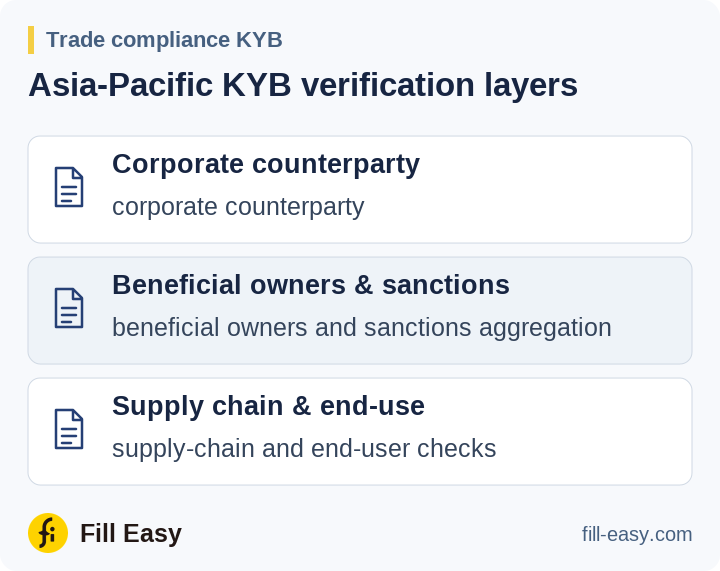
Hong Kong's Significant Controllers Register and Singapore's Central Register of Registrable Controllers are closed to the public, so natural-person beneficial owners require multi-tier corporate tracing or a signed register extract from the counterparty. Japan's commercial extract omits shareholders, requiring the private shareholder register (kabunushi meibo) or listed filings. Mainland China's SAMR report adds court-enforcement and abnormal-operations flags that help spot shell fronts early.
The compliance workflow, step by step
| Step | Action | Source |
|---|---|---|
| 1. Entity capture | Record exact English and local-script name, registration number and physical operating address | Onboarding form; commercial invoice |
| 2. Registry verification | Confirm active status, authorised business scope, directors and direct shareholders | CR, ACRA, SAMR, Legal Affairs Bureau, SSM or ASIC extract |
| 3. Ownership tracing | Pull parent-company records across each intermediate jurisdiction until natural persons or listed parents are reached | Foreign registry extracts; signed ownership chart |
| 4. Restricted-party screening | Screen entity, directors, legal representatives, shareholders, UBOs and shipping addresses | UN, OFAC SDN, BIS Entity List, DFAT, METI, MOFCOM, EU and UK lists |
| 5. Ownership aggregation | Calculate aggregate stakes held by blocked persons and assess effective control or shared directors | Verified shareholder extracts |
| 6. Product & end-use check | Match HS codes and ECCN/strategic-goods lists against registered scope and physical premises | TID, Singapore Customs, METI, BIS lists; End-User Statement |
| 7. Clearance & retention | Record approval rationale and archive timestamped extracts and screening hits | Five-year statutory compliance file |
Complete steps 2 and 3 before issuing purchase orders, open-account credit or export bookings. If a buyer switches consignee or warehouse post-contract, run the new party through steps 1 to 6 before shipment.
Cross-border counterparties and multi-layer ownership
Asia-Pacific trade chains routinely combine a Hong Kong or Singapore contracting vehicle with an offshore parent and a mainland China or ASEAN factory. Verify every corporate shareholder in its own home registry rather than relying on a local subsidiary extract.
Check exact registry coverage across Hong Kong, Singapore, mainland China, Japan, Malaysia, Australia, South Korea, Taiwan (HK$1,225 per search) and Vietnam. For offshore parents, see BVI (HK$725), Cayman Islands (HK$525), UBO tracing in Hong Kong and verifying an overseas company.
Non-Hong Kong companies registered under Part 16 and foreign companies registered with ACRA do not publish full shareholder registers locally; obtain the parent's home-registry record to verify ownership.
Beneficial owners, control and sanctions aggregation
Under the OFAC 50 Percent Rule (opens in a new tab), any entity owned 50% or more in the aggregate, directly or indirectly, by one or more blocked persons is blocked by operation of law even if unlisted. Australia's DFAT autonomous sanctions and EU/UK regimes also capture entities controlled by designated persons below 50% equity.
Under BIS rules, an Entity List designation does not automatically attach to a legally distinct subsidiary unless specified, yet shared addresses, common directors and parent-subsidiary links act as high-priority diversion red flags. Trace natural-person owners down to 25% for routine KYB, and to 10% or lower for dual-use electronics, aerospace parts or sensitive transshipment routes. Watch closely for Singapore ACRA nominee flags (ND for nominee directors, NS for nominee shareholders, displayed since June 2025), which signal an undisclosed nominator.
When enhanced due diligence applies
Escalate to enhanced due diligence when any of these transshipment or evasion indicators arise:
- High-priority dual-use items: Shipments of advanced semiconductors, machine tools or optical equipment routed through Hong Kong, Singapore or Malaysia.
- Newly formed trading fronts: Counterparties incorporated within 12 months with nominal capital and secretarial addresses placing high-value controlled orders.
- Scope and premises mismatch: SAMR scope or ACRA SSIC codes describing textiles or consultancy while ordering avionics or industrial robotics.
- Shared addresses or directors: Overlaps with entities listed on the BIS Entity List, OFAC SDN List or METI End User List.
- Third-party invoicing or rerouting: Payment routed through an unrelated BVI shell or sudden discharge-port changes after licensing.
Pull historical director and shareholder filings, check mainland China abnormal-operations and litigation lists, and obtain a verified End-User Statement before shipping.
Common bottlenecks and refusal triggers
- Opaque offshore parents: A Hong Kong or Singapore buyer is owned by a BVI vehicle whose registered agent will not supply a Certificate of Incumbency.
- Expecting public UBOs in Japan or Australia: Ordering a standard extract only to learn late that neither Japan's Legal Affairs Bureau nor ASIC publishes beneficial owners.
- Romanised China name mismatches: An invoice shows an informal English name that does not match the Chinese legal name tied to the 18-digit USCC.
- Unauthorised signatories: The person signing the contract or End-User Statement is neither a listed director nor the SAMR legal representative, with no board resolution attached.
- Refusal to identify end-users: A distributor declines to confirm the ultimate end-user or insists on unrestricted re-export rights.
Ongoing monitoring and record retention
Share transfers, director changes, SAMR abnormal-operations flags and new OFAC or BIS designations occur continuously after onboarding. Hong Kong strategic-commodities regulations, Singapore's Strategic Goods (Control) Act, Japan's FEFTA and US EAR recordkeeping provisions typically require keeping trade-compliance and counterparty records for five years from export or transaction completion (ten years where US OFAC applies). Pair automated list re-screening with periodic registry refreshes on tier-one and high-risk counterparties.
How Fill Easy supports trade compliance teams
Fill Easy delivers primary company records across Asia-Pacific and offshore holding centres so supply-chain and procurement and vendor onboarding teams verify counterparties without managing local registry portals.
| Workflow stage | Common hurdle | Fill Easy service |
|---|---|---|
| Direct counterparty check | Separate logins and local-language portals across HK, SG, CN, JP, MY and AU | CorpVerify delivers official extracts for HK$100 per search (China with financials HK$710; Taiwan HK$1,225) |
| Multi-layer UBO tracing | Corporate parents sitting in BVI, Cayman, Hong Kong or mainland China | CorpVerify traces corporate layers in one combined order (BVI HK$725; Cayman HK$525) |
| Signatory verification | Checking scanned IDs of Hong Kong, Singapore and mainland China principals | GovVerify verifies individuals via iAM Smart, Singpass and China eID with their consent |
| Portfolio refresh | Manually re-checking approved suppliers before audits | Monitoring and remediation re-checks your supplier spreadsheet and flags director, owner, address and status changes |
Order single checks or supplier batches by email or API. Each result carries the source registry document, retrieval timestamp and your case reference; your team retains all compliance decisions. To configure regional coverage, contact Fill Easy.
FAQ
Which Asia-Pacific registries publish direct shareholders?
Hong Kong, Singapore, mainland China, Malaysia and Australia list direct shareholders in official company extracts. Japan's Legal Affairs Bureau extract omits shareholders, so Japanese ownership must come from the company's private shareholder register or listed filings.
Can I obtain beneficial-ownership registers publicly in Hong Kong or Singapore?
No. Hong Kong's Significant Controllers Register is kept privately at the company's office, and Singapore's Central Register of Registrable Controllers at ACRA is closed to the public. Trace corporate shareholders across registries and request signed controller extracts from the counterparty.
Why do US OFAC and BIS rules affect non-US traders in Asia-Pacific?
US export controls follow US-origin items, software, technology and covered foreign-made products wherever they move. US-dollar settlement or US-person involvement triggers OFAC jurisdiction, and non-US firms face secondary sanctions or BIS Entity List designation for facilitating diversion.
How does the OFAC 50% Rule affect layered Asian corporate structures?
If one or more OFAC-blocked persons hold 50% or more in aggregate of a supplier, directly or through holding companies in Hong Kong, Singapore or offshore centres, the supplier is blocked automatically even if unnamed on the SDN List.
What mainland China SAMR flags indicate a shell trading front?
Recent incorporation with minimal paid-in capital, a registered scope unrelated to the goods ordered, frequent legal-representative changes, an abnormal-operations listing for an unreachable address and active court-enforcement records.
How much does Fill Easy charge for Asia-Pacific supplier searches?
Company searches in Hong Kong, Singapore, mainland China, Japan, Malaysia and Australia cost HK$100 per search (mainland China with financial statements is HK$710). BVI costs HK$725, Cayman Islands HK$525 and Taiwan HK$1,225. All prices are in HKD and turnaround is confirmed when you order.