
Trade compliance and supply-chain KYB in the United States
US trade compliance KYB: verify corporate counterparties under OFAC 50% Rule, BIS EAR Entity List, CBP UFLPA tracing and FCPA rules. Fill Easy: HK$100.
United States · US importers, exporters, multinational manufacturers and trade-finance teams · OFAC, BIS, US CBP, DHS FLETF, DOJ & SEC
Domestic and overseas suppliers, distributors, customs brokers and end-users · Export-control, sanctions, UFLPA and FCPA corporate KYB
 By Matthew Lee


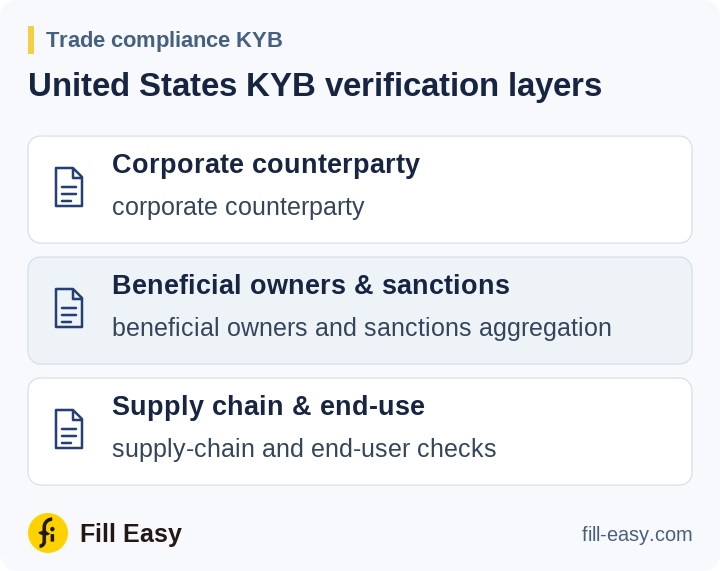
US trade compliance imposes strict-liability civil exposure across economic sanctions, dual-use export controls, forced-labour import bans and foreign anti-bribery enforcement. Importers, exporters and procurement teams operating across New York, Delaware, California, Texas and Washington must verify the legal identity, standing, ownership and operational legitimacy of US counterparties and foreign suppliers before goods clear US Customs or ship abroad.
Because the United States has no single federal company registry and state filings in Delaware, New York, California, Texas and Washington rarely disclose corporate shareholders or LLC members, effective US trade KYB pairs state status checks with overseas parent-company tracing and documentary ownership proof. Fill Easy retrieves US state company searches for HK$100 per state search, with turnaround confirmed when you order.
At a glance
| Core US hubs | New York, Delaware, California, Texas, Washington |
|---|---|
| Federal regulators | OFAC (Treasury), BIS (Commerce), US CBP and DHS FLETF, DOJ and SEC |
| Core statutes & rules | OFAC 50% Rule, BIS Export Administration Regulations (EAR) & Entity List, Uyghur Forced Labor Prevention Act (UFLPA), FCPA |
| Sanctions aggregation | 50% or more aggregate ownership, directly or indirectly, by OFAC-blocked persons blocks the entity automatically |
| State registry limit | State extracts verify formation, status and registered agent, but generally omit shareholders and LLC members |
| Forced-labour standard | UFLPA presumes covered imports are barred unless clear and convincing supply-chain tracing evidence is produced |
| Fill Easy pricing | HK$100 per US state search; HK$100 per additional state document; HK$100 in CN/HK/UK; HK$210 MX; HK$725 BVI; HK$525 Cayman |
| Turnaround | Confirmed when you order; prices in HKD |
Regulatory exposure for trade compliance in the United States
Four federal regimes drive corporate KYB across US-linked supply chains. Under OFAC's Revised 50 Percent Rule Guidance (opens in a new tab), any entity owned 50% or more in aggregate, directly or indirectly, by one or more blocked persons is blocked by operation of law even if unlisted. OFAC's Framework for Compliance Commitments (opens in a new tab) treats weak counterparty ownership verification at onboarding as a core root cause of sanctions violations.
Under the BIS Export Administration Regulations (EAR) (opens in a new tab), controls follow US-origin items, software, technology and covered foreign-produced items worldwide. Exporters must screen every transaction party — purchaser, intermediate consignee, ultimate consignee and end-user — against the Consolidated Screening List (including the Entity List, Unverified List and Military End-User List) and resolve BIS red flags before shipping.
US Customs and Border Protection (CBP) (opens in a new tab) enforces the Uyghur Forced Labor Prevention Act (Public Law 117-78), presuming that goods mined, produced or manufactured wholly or in part in Xinjiang or by an entity on the DHS UFLPA Entity List (opens in a new tab) are barred from US entry unless the importer proves admissibility with clear and convincing tier-by-tier tracing evidence. Simultaneously, the DOJ and SEC enforce the Foreign Corrupt Practices Act (FCPA) (opens in a new tab), creating liability where undisclosed foreign government officials own or control third-party distributors, customs brokers or agents.
Documents and registry evidence
Because US incorporation is state-based while manufacturing chains span overseas registries, trade KYB files combine US state status records with foreign company extracts and private ownership disclosures.
| Document | Issued by | What it is checked for |
|---|---|---|
| Delaware Entity Details & Good Standing | Delaware Division of Corporations | File number, entity type, formation date, active status, registered agent and tax standing (no shareholders or officers) |
| New York DOS Extract & Certificate of Status | New York Department of State | DOS ID, status, county, registered agent, CEO/executive office where filed and biennial statements |
| California Statement of Information (SI) | California Secretary of State | Entity number, active or FTB-suspended status, business address, officers or LLC managers and business type |
| Texas Franchise Tax & SOS Filing | Texas Comptroller / Secretary of State | Taxpayer number, right to transact business, registered agent and Public Information Report officers/directors |
| Washington CCFS Extract & Annual Report | Washington Secretary of State | 9-digit UBI number, active status, activities, governors or officers and registered agent |
| Overseas Supplier Registry Extract | Supplier's home registry (e.g. China SAMR, Mexico RPC, HK CR) | Legal identity, active status, business scope, legal representative and direct corporate or individual shareholders |
| IRS Form W-9 / W-8BEN-E, Cap Table & End-User / UFLPA Certification | Counterparty | EIN/tax classification, non-public US owners/LLC members, tier-two supplier map and export end-use commitment |
Understanding state-filing omissions avoids rework. Delaware omits officers, directors, shareholders and LLC members from standard Entity Details, and California, New York and Washington omit shareholders and private LLC ownership splits. Texas Public Information Reports list corporate officers and LLC managing members but not full cap tables. Verifying a private US LLC or corporation therefore pairs the state extract with a signed ownership declaration, operating agreement schedule or foreign parent extracts.
The compliance workflow, step by step
| Step | Action | Source |
|---|---|---|
| 1. Entity & tax capture | Collect legal name, state or country of incorporation, registration number, EIN/W-9 or W-8BEN-E and physical premises | Onboarding form; IRS tax forms |
| 2. State or home-registry check | Confirm active standing, check for tax forfeiture or administrative dissolution and verify listed officers | State SOS extract (DE, NY, CA, TX, WA) or foreign registry extract |
| 3. Multi-tier ownership mapping | Trace corporate parents and upstream overseas factories across every tier to natural persons or listed parents | Foreign registry extracts; signed cap table or operating agreement |
| 4. Federal list screening | Screen entities, DBAs, officers, shareholders, UBOs, plants and addresses | OFAC SDN, BIS Entity List/UVL/MEU, DHS UFLPA Entity List, DDTC lists |
| 5. 50% Rule & FCPA review | Aggregate blocked-person equity stakes and screen principals for foreign-official or state-owned ties | Verified cap table; PEP and SOE screening |
| 6. ECCN & UFLPA tier check | Confirm EAR licensing for exports and raw-material provenance for UFLPA high-priority imports | Commerce Control List; CBP UFLPA guidance; tier-two factory extracts |
| 7. Approval & recordkeeping | Log screening rationale, embed export/FCPA clauses and retain records for 5–10 years | Compliance archive |
For UFLPA high-priority sectors — polysilicon, cotton, apparel, aluminium, PVC, tomatoes and automotive parts — step 3 must trace past the invoicing trader to upstream factories and mills, backed by home-registry extracts showing no ownership link to listed entities.
Cross-border counterparties and multi-layer ownership
US trade chains routinely connect a Delaware or California importer to offshore parents and manufacturing hubs in China, Hong Kong, Mexico or Europe. Verify every entity in its own registry rather than assuming a state 'foreign qualification' shows overseas shareholders.
Consult the registry guides for United States overview, Delaware, New York, California and Washington. For cross-border supplier and parent corridors, see mainland China, Hong Kong, Mexico (HK$210), BVI (HK$725), Cayman Islands (HK$525) and verifying an overseas company.
Beneficial owners, control and sanctions aggregation
Under OFAC's 50 Percent Rule (opens in a new tab), blocking attaches at 50% or more aggregate ownership by one or more blocked persons — so two blocked parties holding 25% each block the company automatically. OFAC also warns that entities controlled below 50% by a blocked person carry acute designation risk and cannot be used to act for that person.
Under BIS rules, Entity List restrictions attach to the listed entity and addresses rather than automatically to distinct subsidiaries, yet shared premises, common directors or parent ownership trigger severe diversion red flags under BIS Know Your Customer Guidance. Under UFLPA, affiliation or shared ownership with a listed entity triggers CBP detention even when goods invoice from Vietnam or Mexico. For FCPA risk, trace down to 10% for high-risk customs brokers and sales agents to spot minority foreign-official stakes.
When enhanced due diligence applies
- UFLPA high-priority sectors and transshipment: Goods routed via Malaysia, Vietnam or Mexico containing Chinese-origin raw materials or sub-assemblies.
- Recently formed US shell LLCs: Newly incorporated Delaware, Wyoming or New Mexico LLCs using virtual mail drops to purchase EAR-controlled electronics or aerospace parts.
- BIS Unverified List or address hits: Counterparties sharing premises with entities flagged for failed BIS end-use checks.
- FCPA intermediaries: Customs brokers, port agents or local distributors earning success fees in higher-corruption markets.
- Forfeited or suspended state standing: Counterparties listed as FTB-suspended in California, forfeited in Texas or void in Delaware while still issuing invoices.
Common bottlenecks and refusal triggers
- Expecting Delaware or New York extracts to show owners: Ordering only a state certificate and discovering late that no cap table or LLC member list is filed.
- Undisclosed tier-two UFLPA factories: A tier-one trader refusing to identify the legal name and registration number of the actual manufacturing plant.
- DBA mismatches: Invoices using a trade name different from the legal entity on the W-9, state filing or customs entry.
- Refusal to sign BIS-711 or End-User Statements: Foreign buyers declining end-use certification on controlled goods.
- Unscreened third-party payers: Invoices settled by unrelated offshore vehicles in BVI or Dubai omitted from onboarding.
Ongoing monitoring and record retention
BIS EAR (15 CFR Part 762) and CBP customs rules (19 CFR Part 163) require five-year recordkeeping; OFAC requires ten years under the extended federal statute of limitations. Pair continuous OFAC, BIS and DHS list re-screening with periodic registry refreshes on tier-one foreign suppliers and US state status.
How Fill Easy supports trade compliance teams
Fill Easy retrieves US state extracts and overseas supplier records so supply-chain and procurement and vendor onboarding teams build audit-ready OFAC, BIS, UFLPA and FCPA files.
| Workflow stage | Common hurdle | Fill Easy service |
|---|---|---|
| US state verification | Separate Secretary of State portals across DE, NY, CA, TX and WA | CorpVerify delivers official state extracts and Certificates of Good Standing for HK$100 per state search |
| Foreign & UFLPA tracing | Pulling China SAMR, Hong Kong, Mexico or EU factory records across tiers | CorpVerify retrieves primary foreign extracts (HK$100 CN/HK/SG/UK/DE; HK$210 MX) in one order |
| Offshore parent mapping | Tracing BVI or Cayman parents for 50% Rule calculations | CorpVerify combines cross-border searches (BVI HK$725; Cayman HK$525) with retrieval timestamps |
| Portfolio refresh | Re-checking active vendors manually before audits | Monitoring and remediation re-checks your vendor spreadsheet and flags status, officer, shareholder and address changes |
Order by email or API. Each delivery carries the source registry records, retrieval dates and your reference; your compliance team makes every decision. To align coverage with your US supply chain, contact Fill Easy.
FAQ
Do US state registries publish shareholders or LLC members?
No. Registries in Delaware, New York, California, Texas and Washington confirm formation, active status and registered agent, and some list officers or managers, but none publishes full cap tables or LLC member splits. Verify ownership via signed cap tables or operating agreements plus foreign parent extracts.
How does the OFAC 50% Rule apply to multiple blocked owners?
OFAC aggregates direct and indirect stakes across all blocked persons. Two SDN-listed persons each holding 25% of a supplier block it automatically by operation of law even though it is not named on the SDN List.
What corporate records support rebutting a CBP UFLPA detention?
Importers must supply clear and convincing evidence mapping every entity from raw material to finished product. Primary registry extracts proving legal identity, location and ownership across tier-one and upstream manufacturers anchor the evidentiary file.
Does a BIS Entity List designation automatically cover subsidiaries?
Not automatically under the EAR unless specified, unlike OFAC's 50% Rule. However, BIS treats subsidiaries, shared-address affiliates and common-director entities of a listed party as high-priority diversion red flags requiring enhanced due diligence.
How long must US trade-compliance KYB records be kept?
BIS export and CBP customs rules require five-year retention, while OFAC sanctions recordkeeping requires ten years. Retaining timestamped registry extracts and screening logs centrally satisfies all three regimes.
How much does Fill Easy charge for US and overseas supplier searches?
US state searches and additional state documents cost HK$100 each. Overseas hubs including China, Hong Kong, Singapore, Germany and the UK also cost HK$100, Mexico HK$210, Cayman HK$525 and BVI HK$725, in HKD, with turnaround confirmed when you order.