
Trade compliance and supply-chain KYB in the Middle East
Middle East trade compliance KYB: verify mainland and free-zone entities under UAE EOCN, MPCI, Saudi ZATCA and GCC re-export rules. Fill Easy: HK$100.
Middle East · GCC traders, port logistics operators, exporters and regional compliance teams · UAE EOCN, UAE NAIC (MPCI), Saudi ZATCA, Qatar MOCI/QFC, Bahrain MOIC, Oman MOCIIP
Mainland and free-zone trading companies, freight forwarders, shippers and consignees · Trade compliance, re-export screening and supply-chain KYB
 By Matthew Lee


Middle East trade hubs across Dubai, Abu Dhabi, Riyadh, Doha, Manama and Muscat handle high-volume maritime transshipment, energy procurement and regional re-exports where corporate registration splits between mainland commercial licences and separate free-zone registrars. Exporters, freight forwarders and compliance teams must identify the exact licensing authority, confirm active trade-licence status, verify general managers and trace beneficial owners before loading cargo or extending credit.
Public ownership disclosure across Gulf registries is uneven: Saudi Arabia's commercial register report and Qatar Financial Centre (QFC) extracts disclose direct partners or significant shareholders, whereas the UAE National Economic Register (NER) Business License omits shareholders and free-zone ownership sits with zone registrars such as DIFC, ADGM, DMCC and JAFZA. Fill Easy retrieves company searches for HK$100 in the UAE (NER Business License), Saudi Arabia, Bahrain and Qatar QFC; Oman and mainland Qatar are confirmed when you order.
At a glance
| Core regional hubs | Dubai, Abu Dhabi, Riyadh, Doha, Manama, Muscat |
|---|---|
| Trade & customs authorities | UAE EOCN, UAE NAIC (MPCI), Saudi ZATCA, Qatar MOCI/QFC, Bahrain MOIC, Oman MOCIIP |
| Structural KYB split | Mainland emirate DEDs and national registries vs over 40 UAE free zones and QFC |
| Maritime pre-load rule | UAE MPCI requires verified shipper/consignee filings 24 hours ahead (direct/lowest house bills) and 6 hours (master bills) |
| Extraterritorial exposure | US OFAC/BIS re-export enforcement, EU Article 12g and UK OFSI controls on Gulf transshipment |
| Beneficial ownership access | UBO filings are mandatory across GCC hubs but closed to the public |
| Fill Easy pricing | HK$100 in UAE (NER Business License), Saudi Arabia, Bahrain and Qatar QFC; Oman and mainland Qatar confirmed on order |
| Turnaround | Confirmed when you order; prices in HKD |
Regulatory exposure for trade compliance in the Middle East
In the United Arab Emirates, the Executive Office for Control and Non-Proliferation (EOCN) (opens in a new tab) administers targeted financial sanctions (UN and UAE Local Terrorist Lists) and strategic-goods controls under Federal Decree-Law No. 43 of 2021. Traders, brokers and logistics firms must verify counterparties and end-users whenever controlled items move through mainland ports or free zones such as JAFZA, Khalifa Port or DMCC.
For maritime container cargo moving through UAE seaports, the National Advance Information Center (NAIC) enforces mandatory Maritime Pre-Load Cargo Information (MPCI) filings under its MPCI Filing and Compliance Requirements (opens in a new tab) and MPCI Business Specification v1.0 (opens in a new tab). Filings require accurate legal names for the actual shipper and consignee (subject to negotiable-bill rules) 24 hours before vessel loading for direct and lowest-level house bills of lading, and six hours before loading for master and master co-loader bills.
In Saudi Arabia, the Zakat, Tax and Customs Authority (ZATCA) (opens in a new tab) enforces customs clearance, rules of origin and GCC tariffs alongside Ministry of Commerce registration and UBO reporting. Bahrain, Qatar and Oman enforce GCC Unified Customs Law controls and national targeted financial sanctions lists. Because Gulf free zones bridge Asia, Europe and Eurasia, regional distributors also face extraterritorial US OFAC/BIS, UK OFSI and EU Article 12g re-export scrutiny.
Documents and registry evidence
Match each counterparty to its exact mainland or free-zone licensing authority before ordering records, because scope and shareholder visibility differ sharply.
| Document | Issued by | What it is checked for |
|---|---|---|
| NER Business License | UAE Ministry of Economy (National Economic Register (opens in a new tab)) | Trade name (Arabic/English), ERN, issuing authority, licence status, permitted activities and managers (no shareholders) |
| Free-Zone Extract & Trade Licence | DIFC, ADGM, DMCC, JAFZA or other UAE free-zone registrar | Zone legal status, licence expiry, trading vs service scope, directors and shareholders (public in DIFC/ADGM) |
| Saudi Commercial Registry Report | Saudi Ministry of Commerce | Unified national number (700-series), CR number, Arabic trade name, status, activities, direct partners, shares and managers |
| QFC Extract / Mainland MOCI Extract | Qatar Financial Centre (opens in a new tab) or Qatar MOCI | QFC/CR number, active status, activities, directors, secretary and significant shareholders (QFC) or partners (MOCI) |
| Bahrain Sijilat Extract | Bahrain MOIC (Sijilat (opens in a new tab)) | CR number, branch status, active licence, ISIC4 activities, directors, signatories and direct shareholders |
| Oman Commercial Registration Extract | Oman MOCIIP | CR number, legal form, active status, signatories, activities and partners (availability confirmed on order) |
| Notarised MOA, POA & UBO Declaration | Counterparty | Natural-person UBOs, share splits missing from UAE NER licences and general-manager signing powers |
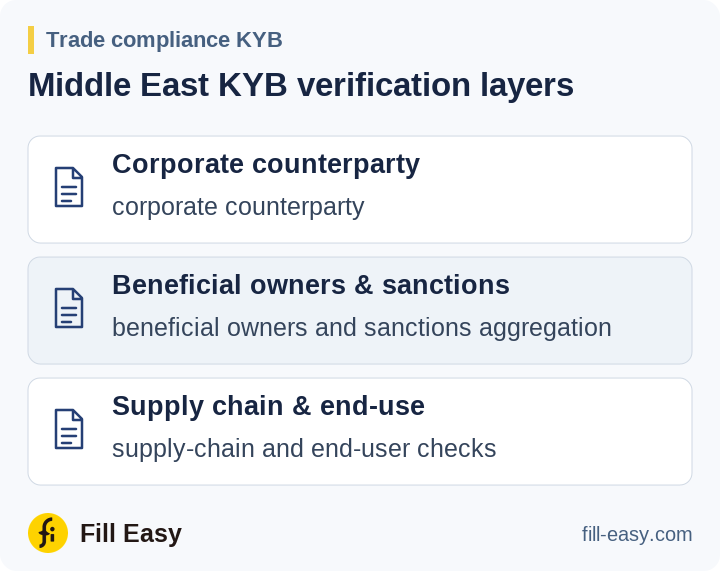
Three regional distinctions matter in practice. First, the UAE NER Business License verifies licence status, activities and managers, not shareholders; mainland LLCs require the notarised Memorandum of Association (MOA), DIFC and ADGM maintain public registers, and commercial free zones such as DMCC and JAFZA hold shareholder records privately. Second, Saudi commercial reports are issued in Arabic and list direct partners without tracing corporate parents. Third, GCC trade licences renew annually — an expired licence halts customs codes even while the company remains on the register.
The compliance workflow, step by step
| Step | Action | Source |
|---|---|---|
| 1. Licensing authority check | Confirm mainland (e.g. Dubai DET, Abu Dhabi ADDED, Riyadh MOC, Qatar MOCI) vs free-zone (DIFC, ADGM, DMCC, JAFZA, QFC) | Trade licence; ERN, CR or QFC number |
| 2. Registry & licence validity | Confirm active status, licence expiry date and permitted trading activities | NER Business License, Saudi CR, Sijilat, QFC or zone extract |
| 3. Signatory & manager check | Verify the person signing contracts, bills or end-user statements against the licence manager or notarised POA | Registry manager field; notarised MOA/POA; UAE Pass where applicable |
| 4. Ownership & UBO tracing | Obtain MOA, zone share register or partner extracts and trace corporate parents across borders to natural persons | Parent registries; signed UBO declaration |
| 5. Sanctions & re-export screening | Screen Arabic/English transliterations, entity, managers, shareholders, UBOs and consignees | UAE EOCN Local List, UN, OFAC SDN, BIS Entity List, EU and UK lists |
| 6. Cargo & end-use check | Verify actual shipper and consignee legal names for UAE MPCI or ZATCA declarations and check onward destination | MPCI pre-load filing; End-User Statement; physical warehouse check |
| 7. Clearance & retention | Retain timestamped extracts, licence expiry alerts and screening decisions | Five-year compliance file |
Tying step 5 screening and MPCI filings to official registration numbers (ERN, 700-number or CR number) eliminates misses caused by inconsistent Arabic-to-English trade-name spellings.
Cross-border counterparties and multi-layer ownership
GCC trading groups commonly hold operating free-zone entities in JAFZA or DMCC under DIFC, ADGM or offshore BVI parents while distributing into Saudi Arabia, Qatar or East Africa. Verify each entity in its own registrar rather than assuming one licence covers affiliates.
Check exact registry scope for UAE, Saudi Arabia, Qatar, Bahrain and Oman. For institutional onboarding context in the UAE, see UAE mainland, DIFC and ADGM, alongside BVI (HK$725) and verifying an overseas company.
Beneficial owners, control and sanctions aggregation
UAE Cabinet Decision No. 109 of 2023 requires mainland and non-financial free-zone companies to file Real Beneficiary Registers (25% ownership or control threshold), with parallel non-public UBO regimes in DIFC, ADGM, Saudi Arabia, Bahrain and Qatar. Because these registers are closed to trade counterparties, compliance teams must aggregate ownership independently across every corporate layer to satisfy UAE EOCN sanctions, OFAC's 50% Rule and EU/UK control tests.
Pay special attention to legacy local-sponsor or side-agreement structures where a nominal majority owner delegates full bank, customs and trading control to a foreign manager under a broad Power of Attorney. Screen both registered owners and effective controlling managers.
When enhanced due diligence applies
- Recently licensed free-zone general traders: Flexi-desk entities formed within 12 months purchasing dual-use electronics, aerospace spares or industrial valves.
- Third-country re-export risk: Goods consigned to Dubai, Sharjah or Oman traders with onward indicators towards Russia, Iran or Belarus.
- Licence-activity mismatch: Consultancy or service licences contracting for physical commodity or machinery shipments.
- Late MPCI consignee switches: Requests to alter a UAE-bound container bill of lading to a 'to order' or newly created free-zone consignee.
- Layered offshore parents: GCC traders owned through BVI, Seychelles or Marshall Islands vehicles without transparent natural-person controllers.
Common bottlenecks and refusal triggers
- Searching the wrong registrar: Querying a mainland database for a DMCC, JAFZA or ADGM company, or accepting an expired licence PDF.
- Expecting UAE NER licences to show shareholders: Relying on the NER extract alone and missing the notarised MOA or free-zone share register.
- Missing manager POAs: Contracts or end-user undertakings signed by staff not named on the commercial licence or a notarised Power of Attorney.
- Untranslated Arabic CR extracts: Relying on unverified summaries of Saudi or mainland Qatar records without confirming exact partners and signing powers.
- Incomplete MPCI filings: Submitting trade names or P.O. Boxes instead of verified legal entity names and addresses, triggering pre-load holds.
Ongoing monitoring and record retention
GCC commercial licences expire annually and managers or partners shift between shipments. UAE AML and export-control rules, Saudi ZATCA customs laws and sanctions regimes generally require five-year retention of due-diligence files and screening logs (ten years where US OFAC applies). Track annual licence renewals and refresh active extracts periodically.
How Fill Easy supports trade compliance teams
Fill Easy retrieves official GCC and global registry records so supply-chain and procurement and vendor onboarding teams verify counterparties without juggling Arabic portals and separate free-zone offices.
| Workflow stage | Common hurdle | Fill Easy service |
|---|---|---|
| GCC registry checks | Navigating UAE NER, Arabic Saudi CR, Bahrain Sijilat, Qatar QFC and Oman portals | CorpVerify delivers official extracts for HK$100 in UAE (NER Business License), Saudi Arabia, Bahrain and Qatar QFC; Oman and mainland Qatar confirmed on order |
| Cross-border parent tracing | GCC traders owned by BVI, Cayman, UK or Asian parents | CorpVerify traces corporate layers in one order (BVI HK$725; Cayman HK$525) |
| UAE signatory checks | Checking scanned IDs of UAE-resident managers and signatories | GovVerify verifies UAE-resident individuals directly via UAE Pass with their consent |
| Licence & status refresh | Re-checking GCC counterparties ahead of annual renewals | Monitoring and remediation re-checks your supplier spreadsheet and flags licence, status, manager and ownership changes |
Order by email or API. Each delivery carries the source record, retrieval date and your reference; your team retains every approval decision. To configure GCC coverage, contact Fill Easy.
FAQ
Does the UAE NER Business License show a company's shareholders?
No. It lists the trade name, ERN, issuing authority, licence status, permitted activities and managers, not shareholders. Obtain the notarised Memorandum of Association for mainland LLCs, DIFC/ADGM public register extracts, or share registers for commercial free zones.
Why does the mainland vs free-zone distinction matter for trade KYB?
Mainland and free-zone entities sit under separate licensing authorities, customs rules and registrars. Free-zone records stay with the zone registrar rather than an emirate Department of Economic Development, and mainland sales typically require customs clearance or a local distributor.
What party checks does the UAE MPCI cargo rule require?
Under NAIC's Maritime Pre-Load Cargo Information rules, covered UAE-bound container shipments need verified legal names and details for the actual shipper and consignee 24 hours before loading for direct and lowest house bills, and six hours before loading for master bills.
Are beneficial ownership registers public across GCC hubs?
No. Companies in the UAE, Saudi Arabia, Bahrain and Qatar file UBO data with authorities, but those registers are closed to the public. Pair direct commercial-register partner lists with signed UBO declarations and parent extracts.
What does a Saudi Arabia Commercial Registry Search Report contain?
Issued in Arabic by the Ministry of Commerce, it lists the unified national number, CR number, trade name, active status, permitted activities, direct partners, shareholdings, managers and capital. Beneficial owners behind corporate partners are not shown.
How much does Fill Easy charge for Middle East company searches?
Fill Easy charges HK$100 per search for UAE NER Business Licenses, Saudi Commercial Registry Reports, Bahrain Sijilat extracts and Qatar QFC extracts, plus HK$100 per additional document. Oman and mainland Qatar availability and pricing are confirmed on order, in HKD.