
Mainland China: corporate life-insurance onboarding
Policyholder, insured-person and beneficiary checks under Mainland China's CDD Measures effective from 1 January 2026.
Mainland China · Life insurers · PBOC / NFRA
Corporate policyholders · Life insurance: AML/CDD review
 By Matthew Lee


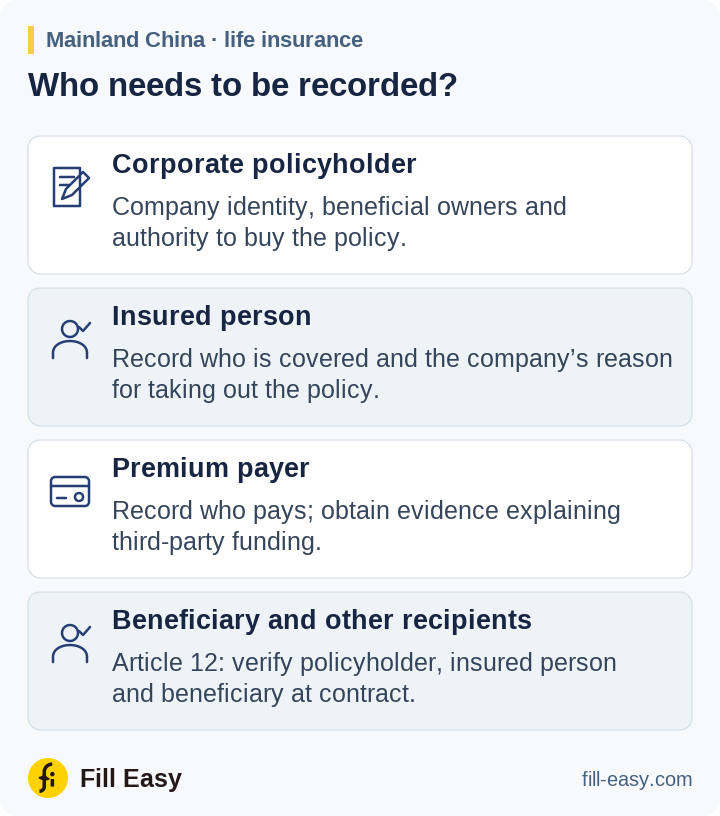
Article 12 of the 2026 CDD Measures requires life and other investment-type insurers to identify and verify the policyholder, insured person and beneficiary when entering the contract. Confirm the relationships between them. Do not defer all beneficiary checks to a claim-stage workflow borrowed from another jurisdiction.
A company taking out the policy
Obtain the company's business licence, registration information and ownership evidence. The Mainland registry guide explains the available company records. Identify beneficial owners and take reasonable measures to verify them under Article 7.
Verify the representative and their authority to buy the policy. A board resolution or written delegation should cover the purchase and identify who can later assign, surrender or amend it. Record the insured person's role and the reason for the company's cover.
Premiums, changes and payment
Establish the premium payer and funding arrangement. If another group company pays, request the intercompany agreement or other evidence explaining that payment. Investigate a change to an unrelated payer, an early surrender or a new recipient before processing it.
识别并核实被保险人、受益人的身份
Customer Due Diligence Measures (2026) — Article 12; Chinese original (opens in a new tab)
English translation: Identify and verify the identities of the insured person and the beneficiary.
在业务关系存续期间,对客户采取持续的尽职调查措施
Customer Due Diligence Measures (2026) (Chinese) — Article 7(4) (opens in a new tab)
English translation: During the business relationship, conduct ongoing customer due diligence.
For a higher-risk corporate beneficiary, Article 21 requires additional checks on its beneficial owners at payout. Apply enhanced due diligence and PEP measures where the relevant risk provisions require them; keep the findings and approvals with the policy file.
Ten-year record retention
Articles 42–44 require customer identity and transaction records to be kept for at least ten years. Preserve beneficiary amendments, assignments and payout evidence alongside the original proposal.